|
Council Meeting
to be held at the Council Chamber, 32 Civic Drive, Greensborough
on Tuesday 30 September 2025 commencing at 7:00 PM.
Agenda
Carl Cowie
Chief Executive Officer
Thursday 25 September 2025
Distribution: Public
Civic Drive, Greensborough
PO Box 476, Greensborough 3088
Telephone 9433
3111
Facsimile 9433
3777
Website www.nillumbik.vic.gov.au
Email nillumbik@nillumbik.vic.gov.au
|

Council Chamber Council Meeting seating plan
|
Cr Kelly Joy
Edendale Ward
|
|
|
|
Cr Peter Perkins
Ellis Ward
|
|
Cr Naomi Joiner
Bunjil Ward
(Deputy Mayor)
|
|
|
|
Cr Kim Cope
Sugarloaf Ward
|
|
Cr Grant Brooker
Blue Lake Ward
|
|
|
|
Cr Kate
McKay
Swipers Gully Ward
|
|
Katia Croce
Manager Governance and Property
|
Blaga Naumoski
Director Governance Communications and Community Safety
|
Cr John Dumaresq
(Mayor)
Wingrove Ward
|
Carl Cowie
Chief Executive Officer
|
|
Council Meeting Agenda 30
September 2025
Nillumbik Shire Council
Agenda of the Meeting of
Nillumbik Shire Council to be held
Tuesday 30 September 2025 commencing at 7:00pm
1. Welcome
Members of the public are advised
the meeting will be livestreamed and recorded and the livestream recording will
be made publicly available on YouTube and Council’s website.
2. Acknowledgement of
Country
Nillumbik Shire Council
respectfully acknowledges and recognises the Wurundjeri Woi-wurrung as the
Traditional Owner of the land on which Nillumbik is located. We pay tribute to
all First Peoples living in the Nillumbik Shire, give respect to Elders past,
present and emerging, and extend our respect to all First Peoples. We
acknowledge that sovereignty was never ceded.
3. Good
Governance Pledge
As
Councillors, we are mindful of our civic responsibilities and obligations. We
pledge to take them seriously, and to carry them out with diligence and
integrity.
We know
the decisions we take will affect the people and environment of Nillumbik, now
and in the future. We undertake, therefore, to make sound and principled
decisions of lasting value, in a spirit of fairness and for the good of all.
We also
pledge to serve the needs and wellbeing of the community and the environment,
in an open and honest manner and to the best of our abilities.
4. Prayer
A
prayer will be read.
5. Apologies/Leave
of Absence
Council
to note any apologies by Councillors not in attendance and or consider requests
for any leave of absence submitted.
6. Declarations
of conflict of interest
Councillors should note that any
conflicts of interest should also be disclosed immediately before the relevant
item.
7. Presentations
THIS PAGE WAS LEFT INTENTIONALLY BLANK
Council
Meeting Agenda 30
September 2025
8. Confirmation of Minutes
Summary
Confirmation of the Minutes of the Council Meeting and
Confidential Council Meeting held on Tuesday 26 August 2025.
|
That Council:
1. Confirms
the Minutes of the Council Meeting (Attachment 1) and Confidential
Council Meeting (Attachment 2) held on Tuesday 26 August 2025
2. Resolves
that the Confidential Council Meeting Minutes (Attachment 2) remain
confidential in accordance with section 3(1) (f) and (h) of the Local
Government Act 2020.
|
Attachments
|
1 . .
|
Confirmation of Minutes
Council Meeting held Tuesday 26 August 2025
|
|
2.
|
Confirmation of
Confidential Minutes Council Meeting held Tuesday 26 August 2025 - Confidential
|
THIS PAGE WAS LEFT INTENTIONALLY BLANK
Council
Meeting Agenda 30
September 2025
11. Reports of Advisory Committees
Distribution: Public
Manager: Blaga
Naumoski, Director Governance, Communications and Community Safety
Author: Katia
Croce, Manager Governance and Property
|
Summary
Council
has a range of Advisory Committees which provide a formal mechanism for
Council to consult with key stakeholders, seek specialist advice and enable
community participation. Although they do not make any formal decisions, they
provide valuable advice to Council.
In accordance with Advisory Committee Terms of Reference,
the following minutes of Advisory Committee meetings are attached (Attachment
1) and presented to Council for noting:
1. Environment
& Sustainability Advisory Committee (ESAC) Minutes meeting held 20 August
2025;
2. Inclusion and Access
Advisory Committee Minutes meeting held 22 August 2025;
3. Recreation Trails
Advisory Committee Minutes meeting held 27 August 2025; and
4. Youth
Council Minutes meeting held 1 September 2025.
|
Attachments
|
1.
|
Advisory Committee
Meeting Minutes reported 30 September 2025
|
|
|
That Council notes the Minutes of the Advisory
Committee meetings reported (Attachment 1).
|
THIS PAGE HAS BEEN LEFT INTENTIONALLY BLANK
Council Meeting Agenda 30
September 2025
12. Officers' reports
Distribution: Public
Manager: Jeremy
Livingston, Director Culture and Performance
Author: David
Taylor, Risk and Safety Lead
Summary
This report provides a summary of
Council’s Risk and Safety Report for the quarter ending June 2025.
The report is presented in accordance
with the Local Government (Planning and Reporting) Regulations 2020,
which requires the presentation of a report to Council at least every six
months, detailing the strategic risks, operational risks, the consequences and
likelihood of occurrence, and risk mitigation strategies.
Risk and Safety reporting to Council
is tabled each quarter following consideration by Council’s Audit and
Risk Committee, which occurred on 1 September 2025.
The full confidential Risk and Safety
Report for June 2025 is attached to this report (Attachment 1) and
provides detailed information for Council’s consideration.
|
That Council:
1. Notes
the summary of the confidential Risk and Safety Report for the quarter ending
June 2025.
2. Resolves
that the Quarterly Risk and Safety Report – June 2025 (Attachment 1)
remains confidential in accordance with section 3(1)(a) and (f) of the Local
Government Act 2020.
|
Attachments
|
1.
|
Quarterly Risk &
Safety Report - June 2025 -
Confidential
|
Discussion
1. Council’s
commitment to risk management is outlined in the Risk Management Policy, with
the following objectives:
· Ensure that all risks that could affect the achievement of
Council’s goals, strategies and actions are identified, assessed and
treated to a commercially and professionally acceptable level of risk
· Integrate risk management into Council’s decision-making
processes and embedding it into the organisational culture
· Ensure necessary resources are allocated in support of the
Policy and supporting Risk Management Framework
· Maintain stakeholders’ trust and due diligence
· Align all risk practices across all systems and to promote
and support a consistent corporate approach to risk that can be clearly understood
· Ensure that risk management is seen as the responsibility
of all staff, i.e. – risk management is everyone’s business.
2. In
addition to the Risk Management Policy, Council’s Risk Management
Framework communicates and describes the risk management principles and
processes that are used to identify, analyse, evaluate, treat, monitor and
communicate key risks, including management reporting.
3. The
context of the Risk Management Policy and Framework takes into account that
local government presents a distinct risk character and profile that needs to
be taken into account when considering risk management. Many assets and
services are available 24 hours a day, seven days a week in an unsupervised
way, some are managed or provided by volunteers or committees of management or
are managed by contractors, others are regulated by compliance legislation.
4. This
Risk and Safety report broadly reports on:
· Risk management
· Business continuity
· (Anti) Fraud and corruption control
· Insurance premiums
· Incident management and insurance claims
· Occupational health and safety.
5. The
Quarterly Risk and Safety Report has been prepared in accordance with
Council’s Risk Management Policy and Framework, and is consistent with
the Australian Standard AS/NZS 31000:2018 Risk Management.
6. The following tables summarise recorded incidents by type
for matters involving Council. Note that these tables show all reported
incidents, rather than all claims, as not every incident results in a
claim being made.
|
All Incidents by
Type
|
Jul - Sep 24
|
Oct - Dec 24
|
Jan -
Mar 25
|
Apr-
Jun 25
|
Total Jul 24 – Jun
25
|
Total
Jul 23 -
Jun 24
|
|
Property
|
18
|
15
|
23
|
13
|
69
|
61
|
|
Motor Vehicle
|
4
|
7
|
13
|
13
|
37
|
40
|
|
Professional Indemnity
|
0
|
0
|
0
|
0
|
0
|
0
|
|
Public Liability
|
28
|
5
|
16
|
24
|
73
|
73
|
|
Occupational Health &
Safety
|
33
|
36
|
37
|
29
|
135
|
130
|
|
Total all incidents
|
83
|
63
|
89
|
79
|
314
|
304
|
7. There were 79
incidents recorded in the June 2025 quarter. The total number of incidents
(314) for the year ending June 2025 was slightly higher compared to the
previous year’s (June 2024) corresponding number of 304.
8. The following table
summarises all incidents by directorate.
|
Incidents by Directorate
|
Jul - Sep 24
|
Oct - Dec 24
|
Jan -
Mar 25
|
Apr-Jun 25
|
Total Jul 24 -
Jun 25
|
Total Jul 23 -
Jun 24
|
|
Culture and Performance
|
7
|
8
|
10
|
7
|
32
|
32
|
|
Governance, Communications and Community Safety
|
13
|
13
|
8
|
6
|
40
|
41
|
|
Planning, Environment and Strategy
|
10
|
0
|
1
|
0
|
11
|
13
|
|
Communities
|
12
|
5
|
9
|
5
|
31
|
36
|
|
Operations
|
41
|
37
|
61
|
61
|
200
|
182
|
|
Total
|
83
|
63
|
89
|
79
|
314
|
304
|
9. A high proportion of reported incidents during the June
2025 quarter are generated within the normal course of business in the
Operations directorate (76%), and represents a minor increase compared
to the previous quarter (68%).
10. All incidents relate to major classes
of asset or maintenance type incidents for Council buildings, recreational
facilities, playgrounds, trees, drainage, footpath, road damage and major
plant.
11. Tree related risks are mitigated
through the:
· Tree
Management Policy
· Reactive
tree maintenance program
· Proactive
electric power line clearance program
· Proactive
box clearance program
· Proactive
inspections of high risk trees
· Meeting the objectives of the Municipal Emergency
Management Plan and Municipal Fire Management Plan.
12. Road,
footpath, drainage and roadside related risks are mitigated through the:
· Road Management Plan
· Road Asset Management Plans
· Proactive and reactive maintenance programs.
13. Property incidents typically reported
are property theft, break-ins, storm damage vandalism and accidental damage to
Council buildings or fixed equipment such as in playgrounds and recreational
facilities. Risks are mitigated through maintenance programs and insurance.
14. There
were 13 property incidents reported during the June 2025 quarter. This is lower
than the corresponding figure from the previous three quarters. A total of 69
property incidents were recorded for the year ending June 2025, which is eight
higher compared to the year ending June 2024.
15. Motor vehicle incidents include
accidental damage involving Council’s light and heavy fleet, including
incidents caused by third parties. Risks are mitigated through maintenance,
education and insurance.
16. There were 13 motor vehicle
incidents during the June 2025 quarter. The total number of motor vehicle
related incidents for the year ending June 2025 (37), was marginally lower
compared to year ending June 2024 (40).
17. Professional indemnity relates to
incidents and claims for alleged negligence or breach of duty arising from an
act, error or omission in the performance of Council services. No new
professional indemnity incidents were received this quarter.
18. Public liability incidents are
reported where the third party is seeking compensation for personal injury,
property damage and economic loss. Note that compensation claims are only paid
where Council has been negligent or there is a clear legal liability. Claims
are managed by an external claims manager or Council’s insurer. Typical
incidents primarily relate to vehicle road damage, property damage, tree
related or trip and fall incidents.
19. There were 24 public liability
incidents reported during the June 2025 quarter and 73 for the year ending June
2025. That is the same number of public liability incidents reported in the
year ending June 2024. Of the reported incidents this quarter, eight related to
slip, trip and fall incidents, five related to tree falling / overhanging, and
four related to tree roots.
20. Council’s four major
leisure facilities recorded 124 incidents in the quarter. Predominate injuries
were sprains/strains, bruise and then pain.
21. Occupational health and safety
incidents during the quarter (29) were noted being safety matters reported as
incidents, hazards and near misses. These incidents are managed through the
Occupational Health & Safety Management System. There were five more
OHS incidents reported for the year ending June 2025 compared to year end June
2024.
22. Incident
costs, including under excess claim costs and insurance excesses, are managed
within existing budgets. Where appropriate, repairs are undertaken and matters
are reported to the Police.
Related Council decisions
23. This
summary, along with the confidential Quarterly Risk and Safety Report, has been
provided to meet the requirements of the Local Government (Planning and
Reporting) Regulations 2020 and consolidation of management reporting.
24. Ongoing
reporting to Council on risk and safety matters is presented quarterly
following each meeting of Council’s Audit and Risk Committee.
Council plans and policies
25. This
report directly supports the achievement of the Council Plan 2021-2025
strategy:
· We are
forward-thinking, data-driven and evidence-led in our decision making, always
looking to identify new opportunities.
· We act in
the best interests of our community.
· We make
Council’s programs, services, processes and information equitable,
assessable and inclusive.
Access, Equity and Inclusion
26. A
Gender Impact Assessment has not been applied to this report.
Sustainability implications
27. Trend
data from this report is used to inform management processes for the mitigation
of risks associated with property, motor vehicle, professional indemnity,
public liability and safety as they relate to Council’s strategic and
operational risks.
28. Council’s
risk profile includes environmental risks and climate change, as a consequence
of failure to adequately mitigate those risks.
Community engagement
29. Not
applicable.
Innovation and continuous improvement
30. Trend
data from this report is used to inform management processes and gap analysis
to identify continuous improvement opportunities associated with property,
motor vehicle, professional indemnity, public liability and occupational health
and safety.
Collaboration
31. Not
applicable.
Budget considerations
32. This
report is part of Council’s monitoring of the Council Plan 2021-2025 and
Budget. The resources for managing and reporting are accommodated within
existing operational budgets.
Relevant law
33. Not
applicable.
Regional, state and national plans and policies
34. Not
applicable.
Conflicts of interest
35. Officers
who have been involved in the preparation of this report declare that they do
not have a conflict of interest in the subject matter of this report.
THIS PAGE WAS LEFT INTENTIONALLY BLANK
Council Meeting Agenda 30
September 2025
12. Officers'
reports
Distribution: Public
Manager: Jeremy
Livingston, Director Culture and Performance
Author: Robert
Malignaggi, Acting Chief Financial Officer
Summary
In accordance with section 53 of the Local
Government Act 2020 and good governance principles, councils must have an
Audit and Risk Committee.
As resolved at the 25 June 2024 Ordinary
Council Meeting, the minutes of an Audit and Risk Committee meeting are to be
reported and presented to a subsequent Council Meeting.
The Audit and Risk Committee met on 1 September 2025. The
minutes for the meeting are shown in Attachment 1.
|
That Council notes the Minutes of the Audit and
Risk Committee meeting held on 1 September 2025 (Attachment 1).
|
Attachments
|
1.
|
Audit and Risk
Committee Minutes - September 2025
|
Discussion
1. The
minutes of the Audit and Risk Committee (ARC) are submitted to Council after
each meeting. To provide timely feedback, these are unconfirmed minutes.
2. Minutes
of the ARC held on the 1 September 2025 have been adopted by the Committee, and
will be presented at its next meeting.
3. The
items considered by the ARC were:
· Draft 2024-2025
VAGO Final Audit Management Letter and Draft Closing Report
· Annual Financial
Report and Performance Statement for the year ended 30 June 2025
· Annual Follow Up
Internal Audit report
· Internal Audit
Report
· Quarterly Risk and
Safety report
· Cyber Security
dashboard
· AI Policy
· Finance policies
and Procurement Policy
· Rates in Arrears
report
· Staff Smoking,
Vaping, Drugs and Alcohol Policy
· Councillor
Expenses report.
4. The
next ARC meeting is scheduled to take place on Monday 17 November 2025.
Related Council decisions
5. As
resolved at the 25 June 2024 Ordinary Council Meeting, the minutes of an ARC
meeting are to be reported and presented to a subsequent Council Meeting.
Options
6. The
ARC’s function is to assist Council in the effective conduct of its
responsibilities for financial reporting, management of risk, maintaining a
reliable system of internal controls and facilitating good and ethical
governance.
7. The
ARC meets four times a year. The Internal Auditor, CEO and Chief Financial
Officer attend all Audit and Risk Committee meetings. Other management
representatives attend as required to present reports. The external auditors
attend in May and September each year to present the Audit Plan and independent
audit report.
Council plans and policies
8. This
report directly supports the achievement of the Council Plan 2021-2025
strategy:
· We continue to
exercise sustainable and responsible financial management.
Access, Equity and Inclusion
9. Where
applicable, the ARC considers Gender Access, Equity and Inclusion.
Sustainability implications
10. The
ARC plays a significant role in Council’s governance framework. It
provides external expert advice to Council on key areas of risk. Risk in this
case is interpreted broadly and covers risk to Council’s sustainability,
reputation, fraud control and effectiveness, as well as financial risk.
Community engagement
11. Not
applicable.
Innovation and continuous improvement
12. Not
applicable.
Collaboration
13. The
ARC meeting on 1 September 2025 was attended by VAGO representatives from HLB
Mann Judd (the external auditor), the internal auditor from Pitcher Partners,
as well as the CEO and CFO. Mayor Cr John Dumaresq and Deputy Mayor Naomi
Joiner attended as the Councillor representatives.
Budget considerations
14. The
associated costs are contained within Council’s 2025-2026 Budget.
Relevant law
15. Section
53 of the Local Government Act 2020 requires that Council must establish
an Audit and Risk Committee.
Regional, state and national plans and policies
16. Not
applicable.
Conflicts of interest
17. All
officers involved in the preparation of this report have made a declaration
that they do not have a conflict of interest in the subject matter of this
report.
THIS PAGE WAS LEFT INTENTIONALLY BLANK
Council Meeting Agenda 30
September 2025
12. Officers'
reports
Distribution: Public
Manager: Jeremy
Livingston, Director Culture and Performance
Author: Robert
Malignaggi, Acting Chief Financial Officer
Summary
Council is
required to produce an Annual Financial Report, containing audited financial
statements and an audited Performance Statement pursuant to the requirements
and process outlined in the Local Government Act 2020 (the Act) and the Local
Government (Planning and Reporting) Regulations 2020.
The draft
2024-2025 financial statements and the draft 2024-2025 performance statement
have been reviewed by Council’s external auditors on behalf of the
Victorian Auditor General.
For the
2024-2025 financial year, Council has reported an operating surplus of $1.083
million on an accrual basis.
This report
recommends that Council approves in principle the 2024-2025 financial
statements and performance statement and appoints the Mayor, Deputy Mayor and
Chief Executive Officer to sign the 2024-2025 financial statements and the
2024-2025 performance statement.
Council has
produced a performance statement in accordance with the Local Government
Performance Reporting Framework. This provides results on a range of prescribed
indicators of service performance, financial performance and sustainable
capacity.
The draft statements have
been presented to Council’s Audit and Risk Committee which has
recommended that Council give in principle approval for the statements pursuant
to section 99 of the Act, prior to formal presentation to the Victorian Auditor
General.
|
That Council:
1. Approves
‘in principle’ the 2024-2025 Annual Financial Report (Attachment
1) and 2024-2025 Performance Statement (Attachment 2).
2. Authorises the Mayor, Deputy Mayor and the Chief Executive Officer to
sign the 2024-2025 Annual Financial Report and the 2024-2025 Performance
Statement in their final form after any changes recommended, or agreed to, by
the auditor have been made.
|
Attachments
|
1 . .
|
DRAFT 30 June 2025
Financial Report
|
|
2.
|
DRAFT 30 June 2025
Performance Statement
|
Discussion
1. Council is
required to produce an Annual Financial Report, containing audited financial
statements and an audited Performance Statement pursuant to the requirements
and process outlined in the Local Government Act 2020 (the Act) and the Local
Government (Planning and Reporting) Regulations 2020.
2. Section 99 of
the Local Government Act 2020 and the Local Government (Planning and Reporting)
Regulations 2020 require Council to:
a) Adopt a resolution giving
its approval, ‘in principle’, to the Annual Financial Report and
Performance Statement before they are submitted to the Auditor General.
b) Authorise two Councillors
and the Chief Executive Officer to certify the statements in their final form,
after any changes recommended, or agreed to, by the auditor have been made.
3. Audit work has
been completed by Council’s external auditors and officers have prepared
drafts of the 2024-2025 Financial Report and Performance Statement for submission
to the Auditor General. A copy of these statements, forming the ‘in
principle’ statements, is provided in Attachment 1 and 2.
4. The Statements
were presented to the Audit and Risk Committee on 1 September 2025. In
performing its duties and responsibilities of oversight of the external audit
function as set down in its Charter and required under statute, the Audit and
Risk Committee:
1. Informs Council that the Committee has
received and considered:
a) the
Annual Financial Report (comprising audited Financial Statements) and the
audited Performance Statement for the financial year ending 30 June 2025
(‘Audited Statements’); and
b) the
External Auditor’s Closing Report and Final Management Letter relating to
the audit process for the Audited Statements;
2. Assures Council that the Committee has
raised and discussed with the External Auditor and management all matters it
has identified as part of such consideration and is satisfied with
clarifications and advice it has received from the External Auditor and
management;
3. Is satisfied from its enquiries that there
are no incomplete or unresolved matters of a material nature pertaining to the
audit that prevents the Committee from providing the following recommendations
to Council;
4. Based on the Committee’s
considerations and enquiries, recommends that Council pass a resolution:
a) giving
its approval in principle to the Audited Statements;
b) authorising
the Chief Executive Officer to submit the approved-in-principle Audited
Statements to the Victorian Auditor-General’s Office (VAGO) for reporting
on the audit;
c) if
any subsequent changes recommended or agreed by VAGO are to be made to the
approved-in-principle Audited Statements, authorising Council’s Principal
Accounting Officer:
i. to
make any changes that are of a non-material nature; and
ii. to
make any changes that are of a material nature after first consulting with the
Committee’s Chairperson;
d) requiring
that Council’s Principal Accounting Officer prepare a summary of any
changes made to the approved-in-principle Audited Statements to enable them to
be presented in their final form and provide this summary to both Council and
the Committee for their noting;
e) authorise
the certification (signing) of the final form of the Audited Statements by the
Mayor, the Deputy Mayor and the Chief Executive Officer.
Approval Process
5. The following
process is required to ensure that Council’s Financial Report and
Performance Statement are submitted to the Auditor General in a timely manner,
enabling the Auditor General to officially express his opinion prior to the
statutory deadline of 31 October 2025:
a) Council must meet
formally to review the draft Financial Report and Performance Statement, and
resolve that Council approves the report and statements ‘in
principle’ and authorises two Councillors and the Chief Executive Officer
to sign the final report and statements on behalf of, and with the full
authority of, Council. The ‘in principle’ report and statements and
the Council resolution are given to the external auditor;
b) The external auditor
checks the ‘in principle’ report and statements. The report and
statements, the Council resolution, and the external auditors recommended Audit
Report will then be forwarded to the Auditor General for review;
c) The Auditor General
reviews the report and statements and requests any changes where appropriate;
d) The Principal
Accounting Officer (Chief Financial Officer) then considers the Auditor
General’s requested changes and incorporates them into the ‘in
principle statements’, where appropriate;
e) The Principal
Accounting Officer will identify any matters of significance, including
proposed qualification issues, not previously considered by the Council and
formally draw Council’s attention to them prior to the formal sign off of
the statements by the two designated Councillors and the Chief Executive
Officer;
f) If Council and
the Auditor General are satisfied with the statements, the statements are to be
signed by the delegated Councillors and the Chief Executive Officer and
forwarded to the Auditor General;
g) The Auditor
General’s Audit Reports will be issued to the Council once the formally
signed statements have been received and checked by the Auditor General; and
h) The
organisation’s 2024-2025 Annual Report, including the audited Financial
Report and Performance Statement, must be forwarded to the Minister by 31
October 2025.
Performance Statement
6. Council
has produced a Performance Statement in accordance with the Local Government
Performance Reporting Framework.
7. The Performance
Statement reports the audited results for 2024-2025 for the prescribed
indicators of service performance, financial performance and sustainable
capacity.
8. The financial
performance and sustainable capacity indicators include several of the
indicators used by the Victorian Auditor-General to assess the financial
sustainability of local government.
9. The overall
assessment of Council’s financial sustainability will be confirmed by the
Auditor-General in the annual report on Victorian local government in late
2025, which will also confirm the indicators to be applied for 2025-2026.
10. In addition to the audited
Performance Statement, the results for a range of other indicators are reported
in the Report of Operations as part of the Annual Report.
Related Council decisions
11. Not applicable.
Options
12. It is recommended that
Council give ‘in principle’ approval to the 2024-2025 Annual
Financial Report, which includes the financial statements and the Performance
Statement and authorise two Councillors and the Chief Executive Officer to sign
the statements in their final form after any changes recommended, or agreed to,
by the auditor have been made.
Council plans and policies
13. This report directly
supports the achievement of the Council Plan 2021-2025 strategy:
· We continue to exercise sustainable and responsible
financial management.
Access, Equity and Inclusion
14. A Gender Impact Assessment
was conducted and Gender Responsive Budgeting included within the guidelines as
a priority consideration throughout the budget development process.
Sustainability implications
15. Council’s financial
sustainability is informed by the indicators set by the Victorian Auditor
General’s Office (VAGO).
16. These indicators comprise
of both short term and longer term measures. The indicators are calculated and
considered as part of the performance statement.
Community engagement
17. The Annual Financial
Report and Performance Statement will be published within Council’s
Annual Report 2024-2025.
Innovation and continuous improvement
18. Not applicable.
Collaboration
19. The Annual Financial
Report and Performance Statement was presented to the Audit and Risk Committee
in September 2025.
Budget considerations
20. The costs of preparing the
Annual Financial Report and Performance Report are funded from operating budget
allocations.
Relevant law
21. Section 98 and 99 of the Local
Government Act 2020 applies to the collation and approval of the Annual
Financial Report and Performance Statement.
Regional, state and national plans and policies
22. Not applicable.
Conflicts of interest
23. All officers involved in
the preparation of this report have made a declaration that they do not have a
conflict of interest in the subject matter of this report.
THIS PAGE WAS LEFT INTENTIONALLY BLANK
Council Meeting Agenda 30
September 2025
12. Officers'
reports
Distribution: Public
Manager: Jeremy
Livingston, Director Culture and Performance
Author: Craig
King, Manager Customer Experience and Business Performance
Summary
This report presents the Council Plan 2025-2029,
incorporating the Community Vision, (Attachment 1) for adoption. This
follows public consultation, receipt of submissions and refinements to the plan
in response to the submissions received.
This report also presents the Annual Action Plan 2025-2026 (Attachment
2) for adoption, which comprises 55 actions that align with the adopted
Annual Budget 2025-2026 and supports the first year delivery of the new Council
Plan. Reporting updates will be received by Council on a quarterly basis that
will demonstrate in a practicable and tangible way how the Council Plan
2025-2029 is being delivered to the community.
The Council Plan is the Council’s primary strategic
document for its four-year term, and is the elected Council’s statement
of its priorities for the Nillumbik community. The Council Plan is a requirement
under section 90 of the Local Government Act 2020 (the Act) and
must be adopted by 31 October 2025.
The information and community feedback gathered through the
Nillumbik Now and Beyond community engagement program undertaken in February
and March of this year has helped inform the development of the Council Plan. A
two-day Community Forum in May 2025 brought together a randomly selected,
representative group of 20 residents to explore key themes and priorities in depth.
A series of workshops and briefings with Councillors were also undertaken in
the development of the Council Plan. The Draft Council Plan 2025-2029 was then
subject to public exhibition and community consultation between 18 June to 9
July 2025.
The Planning and Consultation Committee considered a report
outlining the 16 written submissions received, and at the meeting on 12 August
2025 the Committee heard verbal submissions from 6 presenters.
Having considered
the feedback from the written and verbal submissions, some refinements to the
Council Plan have been made, and these are documented in this report.
The above-mentioned community feedback also identified
strong support for the existing Community Vision, which has now been
incorporated into the Council Plan and is proposed to remain unchanged. However,
in order to meet the requirements of Section 88(4) of the Act, the Community
Vision requires re-adoption.
|
That Council:
1. Adopts
the Council Plan 2025-2029 (Attachment 1) containing amendments and suggestions
in response to the submissions received following public consultation.
2. Adopts
the Annual Action Plan 2025-2026 (Attachment 2) and notes that Council will receive
quarterly updates on progress of actions in accordance with this plan.
3. Authorises
the Director Culture and Performance to make any further minor changes to the
Council Plan that may be necessary and are inconsequential in nature.
4. Notes that the Community Vision has
been reviewed, is now incorporated into the Council Plan, and is re-adopted
as required by Section 88(4) of the Local Government Act 2020, with no
changes made.
5. Makes the adopted Council Plan
2025-2029 and accompanying Annual Action Plan 2025-2026 publicly available on
Council’s website.
6. Thanks submitters and advises them of
the outcome of the consultation process.
|
Attachments
|
1.
|
Council Plan 2025-2029
|
|
2.
|
Annual Action Plan
2025-2026
|
Discussion
1. The
Local Government Act 2020 (section 90) requires all Victorian councils
to prepare a Council Plan for its four-year term, and to complete this by 31
October in the year following a general election.
2. The
Council Plan is the key strategic document guiding the direction and objectives
of the Council during its four-year term. The Council Plan is the elected
Council’s statement of its priorities for the Nillumbik community.
3. The
information and community feedback gathered through the Nillumbik Now and
Beyond community engagement program undertaken in February and March of this
year, along with a deliberative community forum held in May has helped inform the
development of the Council Plan 2025-2029 (Attachment 1).
4. The
Council Plan has also been developed and refined through a series of workshops
and briefings with Councillors.
5. The
Council Plan 2025-2029 identifies four themes that align with the four themes
within the Community Vision. The four themes in the Council Plan are:
· Our People –
Inclusive living and participation
· Our Place –
Liveable and connected communities
· Our Future –
Sustainable futures and healthy environments
· Our Council
– Responsible governance and community leadership.
6. An
objective, a set of strategies, priority actions and strategic indicators are
included under each theme. Council services and key strategy and planning
documents have also been included to show their alignment with the Council
Plan.
7. Following
the feedback received via submissions from public consultation period, minor
changes have been included in the Plan, along with some other refinements which
are now included in the final version of the plan.
8. These
changes include:
a) A
reinforced commitment to biodiversity and environmental protection; including
targeted measures to improve road and wildlife safety, protection and
enhancement of Nillumbik’s tree canopy and the safeguarding of the
environmental and cultural significance of the Green Wedge.
b) An
emphasis on inclusive participation; ensuring decision making processes
actively engage a broach cross-section of the community, with a focus on
equity, accessibility and the representation of diverse voices.
c) Encouraging
more opportunities for unstructured social connection; supporting the use of
shared trails, playgrounds, dog parks and community spaces where people can
meet informally and build community connections.
d) Recognising
the importance of housing diversity to support ageing in place; advocating for
a range of housing options that allow residents to stay connected to their
community, services and social networks at every stage of life.
e) Working
towards reconciliation; embedding respect, acknowledgement and partnership with
the Wurundjeri Woi-wurrung in Council’s planning, programs and community
initiatives.
9. The
Council Plan 2025-2029 includes the existing Community Vision statement. This
statement has been reviewed and no changes are proposed to be made.
10. Through
the Nillumbik Now and Beyond survey and Annual Community Survey undertaken in
February, 61% of the community supported the Community Vision with no changes,
stating that it still resonates. The Community Forum also reviewed the
Community Vision and recommended no changes be made to the existing vision
statement.
11. Each
year, Council will deliver the Council Plan through an Annual Action Plan,
linked to the annual budget, which sets out the specific actions to achieve the
plan’s objectives and strategies over the four years.
12. An
Annual Action Plan for the 2025-2026 financial year (Attachment 2) has
been prepared, and is also presented with this report for adoption. The Annual
Action Plan 2025-2026 comprises 55 actions which align with the adopted Annual
Budget 2025-2026 and supports the first year delivery of the new Council Plan.
13. Reporting
updates will be received by Council on a quarterly basis that will demonstrate
in a practicable and tangible way how the Council Plan 2025-2029 is being
delivered for the community.
14. A
full graphic designed version of the Council Plan is being prepared, and will
be available on Council’s website following the adoption of the plan.
Related Council decisions
15. On
17 June 2025, Council endorsed the Draft Council Plan 2025-2029 for the
purposes of community consultation ending on 9 July 2025.
16. On 12 August 2025, the Planning and
Consultation Committee considered a report on the submissions received in
response to the Draft Council Plan, and Council received 6 verbal presentations
from a number of submitters.
17. Council
resolved to receive and note those submissions, considered those submissions in
the finalisation of the Council Plan, and noted that a report will be presented
to the 30 September 2025 Council Meeting to consider its adoption.
Options
18. Adopt
the Council Plan 2025-2029.
Council plans and policies
19. This
report directly supports the achievement of the previous Council Plan 2021-2025
strategies:
· We
maintain good governance and transparency; clearly defining and communicating
the role of Councillors and Council.
· We
communicate clearly and regularly, taking the time to listen and engage with
our community.
Access, Equity and Inclusion
20. Council
recognises that it has a role in creating a more fair and equal society by
playing an important role in supporting, facilitating and working with
community to empower people to have their say and help shape the future of the
Shire.
21. The
development of this Plan has been guided by the principles outlined in
Council’s Access, Equity and Inclusion Policy.
22. Equity
Impact Assessments (EIA) have been undertaken at multiple stages of the
process, including assessments of the community engagement approaches, analysis
of data and review of the draft plans.
23. An
accessible, plain language poster summarising the Plan will also be developed
to make key messages easy to understand and share across the community.
24. As
the Plan is delivered, officers will assess actions and conduct EIAs where
appropriate to ensure the actions are fair, inclusive and reflect the needs of
the community in line with the Gender Equality Act 2020.
Sustainability implications
25. The
Plan supports Council to act in the best interests of the community by
promoting social, economic and environmental sustainability.
26. The
Council Plan guides decision-making that is realistic and achievable within
available resources, ensuring sustainable outcomes over the long term.
This includes balancing community priorities with Council’s capacity to
deliver.
Community engagement
27. Through
the Nillumbik Now and Beyond community engagement program in February and March
2025, Council sought broad community input to inform the development of the
Council Plan. Engagement included surveys, pop-up sessions across the Shire,
workshops, and targeted outreach activities to capture diverse perspectives and
experiences.
28. Complementing
the broad-based community engagement program was a 2-day Community Forum held
in May. The Forum brought together a randomly selected representative group of
20 residents to explore key themes and priorities in depth.
29. These
sessions, along with Councillor input, ensured that the development of the
Council Plan was informed by diverse perspectives, sector expertise, and
alignment with community priorities.
30. The
Draft Plan was the subject of a public consultation period from 18 June –
9 July 2025 where community members and groups had the opportunity to provide
their feedback.
31. The
Planning and Consultation Committee considered a report outlining the 16
written submissions received, and at the meeting on 12 August 2025 the
Committee heard verbal submissions from 6 presenters.
Innovation and continuous improvement
32. Opportunities
for innovation and continuous improvement have been identified through the
development of the draft Plan, which include:
· Improved
integration between strategic documents
· Enhanced
engagement processes.
33. Further
opportunities are expected to emerge during implementation of the Plan and
through the ongoing review of supporting strategies and plans.
34. The
focus will be on strengthening integration across Council services, fostering
collaboration with external partners, and delivering improved outcomes for the
community.
Collaboration
35. Partnerships
and collaboration have played and will continue to play an integral role in the
implementation of the Plan.
36. Council
will continue to work with other levels of government, agencies and the
community in order to achieve the strategies within the plan.
Budget considerations
37. The
Plan is a high-level strategic document and does not make specific budget
commitments.
38. Each
year, in line with the budget process, Council will produce an Annual Action
Plan identifying how Council will work towards achieving the objectives and
strategies of the Council Plan.
39. Council
priorities, strategies and plans, major projects, capital works, service
improvements as well as other actions will be set out in the Annual Action
Plan.
40. The
cost of preparing and adopting the Council Plan, including design and public
consultation processes, is met from the operating budget.
Relevant law
41. The
Local Government Act 2020 requires Council to prepare a four-year
Council Plan (section 90), informed by a Community Vision (section 88), to
ensure that Council’s strategic direction reflects the aspirations and
priorities of the community.
42. The
Council Plan has been developed in alignment with these legislative
requirements and builds on the Nillumbik Community Vision 2040, originally adopted
in 2021, which is now fully integrated into the Council Plan document.
Regional, state and national plans and policies
43. In
accordance with section 9 of the Local Government Act 2020, Council must
give effect to overarching governance principles, including consideration of
regional, state and national plans and policies in its strategic planning and
decision-making.
The Plan also aligns with broader
state and national frameworks, including:
· Victorian
Local Government Performance Reporting Framework (LGPRF) – supporting
transparency and accountability in planning and reporting.
· Plan
Melbourne 2017-2050 – particularly regarding housing choice, transport
connectivity, and 20-minute neighbourhood principles.
· Gender
Equality Act 2020 – through Council’s Gender Equality Action
Plan and Equity Impact Assessments for actions with significant community
impacts.
· Climate
Change Act 2017 – through alignment with Council’s Climate
Action Plan 2022–2032 and actions supporting climate resilience.
· Public
Health and Wellbeing Act 2008– as reflected in the integration of
health and wellbeing priorities through Council’s Municipal Public Health
and Wellbeing Plan.
Conflicts of interest
44. Officers who have been involved in
the preparation of this report declare that they do not have a conflict of interest
in the subject matter of this report.
Council Meeting Agenda 30
September 2025
12. Officers'
reports
Distribution: Public
Manager: Blaga
Naumoski, Director Governance, Communications and Community Safety
Author: Michele
Purtle, Manager Advocacy Communications and Engagement
Summary
The Communications Strategy 2022-2025 (Attachment 1)
was adopted by Council on 26 July 2022 as a priority action of the Council
Plan 2021-2025.
Its aim is to enhance the connection between
Nillumbik’s residents and the information they seek regarding Council
programs, services and decisions.
The Strategy outlines an Action Plan with 36 priority
actions of which nine actions were included in the Year 3 Action Plan
(including seven ongoing actions carried forward from the Year 2 Action Plan).
The purpose of this report is to present the Year 3 Action
Plan Outcomes Report (Attachment 2) to Council and conclude the Communications
Strategy 2022-2025 with a review of the key achievements of the Strategy as
identified in the Highlights Report - From then to now (2021-22 to 2024-25) (Attachment
3). Learnings from this Strategy will be built into the new communications strategy
that will be developed late 2025 to reflect the actions of the new Council Plan
2025-2029.
|
That Council endorses the Communications Strategy
2022-2025 Year 3 Action Plan Outcomes Report and the Communications Strategy
2022-2025 Highlights Report which provides an overview of the key
achievements of the Strategy.
|
Attachments
|
1.
|
Communications Strategy
2022-2025
|
|
2.
|
Communications Strategy
2022-2025 Three Year Action Plan
|
|
3 . .
|
Communications Strategy
2022-2025 Highlights
|
Discussion
1. The
Communications Strategy 2022-25 was adopted by Council on 26 July 2022
as a priority action of the Council Plan 2021-2025.
2. The
Strategy has been made available on Council’s website in PDF format, an
Accessible Word version, and an Easy Read document, in line with our commitment
to access, equity and inclusion.
3. The
strategic objective of the Strategy is to improve how Nillumbik’s people
are connected to the information they need and want about relevant Council
programs, services and decisions, to enable them to live supported, active,
sustainable and connected lives within our community.
4. There
are four Pillars of Action:
· Trust
and transparency: use two-way communications to seek community input and
enhance our transparency about why we’ve made decisions or taken actions.
· Identity:
enhance the Nillumbik identity by embedding a strong visual presence and
consistent and engaging messaging.
· Capability:
build council capacity to clearly communicate and champion Council and
community priorities to our community and other stakeholders.
· Reach:
improve our digital presence with more engaging content tailored to people
already using the web and social media. Strengthen our non-digital
communications options to cater to people who are not online and/or require
alternative formats.
5. The
Year 3 Action Plan includes nine actions, incorporating seven of the actions
carried over from Year 2.
Key achievements during the third
and final year of the Strategy include:
· Supporting
more than 331 communication projects or requests, issuing 120 website news
stories and 76 media releases.
· Implementing
a website auditing tool (Siteimprove) to test website accessibility. In 2025,
the website scored a very good 83.9 out of 100 against accessibility
standards. We are continuously improving website accessibility by
reducing non-compliant PDFs and converting content to accessible HTML formats.
· Leveraging
data from trackable QR codes, websites, Participate Nillumbik, social media and
quarterly dashboards to support decision-making and improvements to Nillumbik
News and web content. This has improved our capability to offer more timely
messages digitally to compliment the printed magazine, addressing feedback
requesting more frequency of news.
· Implemented
a communications channel audit to support planning and optimising a multimodal
targeted communications approach, ensuring we are reaching the appropriate
audience through multiple channels to enhance message effectiveness and
retention while improving access for community.
· Developing
a draft Social Media Policy, undertaking in-depth social media analysis,
drafting Social Media Guidelines and establishing new criteria for the
Communications and Engagement Coordinator role to support and oversee strategic
implementation and enhance effectiveness of social media channels.
· Introducing
a new staff welcome email with key resources and services outlined, including
an invitation to one-on-one training for some roles. Equipping staff and new
starters to champion best-practice communication, branding, and accessibility.
· Developing
a digital Writing Style Guide with a renewed focus on inclusive language and
accessibility. Making this available online provides easy access for staff and
allows the Guide to be updated instantaneously.
· Completing
an audit of community and Council noticeboards and analysing their
effectiveness to identify risks and opportunities. Following findings of
current inefficiencies and limited effectiveness of physical noticeboards,
Council is now exploring opportunities for electronic community noticeboards.
6. The
Communications Strategy 2022-2025 concluded in July 2025 with all 36
priority actions now complete. Many key initiatives implemented through the
Strategy have been translated and embedded into our ongoing communications
approach.
Key achievements and
outcomes from the Strategy include:
· Integrating
the Community Engagement Toolkit, policy, guidelines, and templates into
project planning, along with stakeholder mapping to better identify and engage
key groups. The approach is supported by 45 Community Engagement Champions who
meet quarterly, and 30 staff across the organisation who have completed IAP2
Community Engagement Essentials training.
· Building
a bigger, more connected community engagement audience through the Participate
Nillumbik website, increasing awareness of the platform from 11 per cent to 22
per cent, with active users growing from 2.3 per cent to 9 per cent, and
members increased 123 per cent – from 1,254 in 2022 to 2,796 in 2025.
· Growing
the number of subscribers to the community engagement enewsletter, from 1,667
in 2021 to 2,418 subscribers in 2025. Engagement with the enewsletter has
steadily increased with the average open rate lifting from 51 per cent to 57.7
per cent.
· Boosting
the number of subscribers to Nillumbik eNews by 138 per cent. Nillumbik eNews is
ranked in the Top 5 for enewsletter open rates, outperforming 20 larger
councils with a 62 per cent open rate in 2025 (global government average is 40.5
per cent). This far exceeds our target of 50 per cent. Targeted promotions,
tailored newsletter content and engaging videos have contributed to the
success.
· The
2025 Annual Community Survey found that enewsletters are residents’
preferred method of receiving information from Council, with 46 per cent of
participants nominating this form of communication.
· Increasing
the number of followers accessing information and updates from Council across
social media channels. Council’s Facebook page grew by 25.8 per cent,
Instagram by 49.9 per cent and LinkedIn by 61.8 per cent.
· Engagement
rates soared by 66.5 per cent in total across Council social media channels
including Facebook, Instagram and LinkedIn. Highlights include Council’s
organic engagement on Facebook increasing by 88.6 per cent and LinkedIn lifting
to 17.2 per cent. This exceeded our target of increasing engagements on socials
by 20 per cent. These results reflect actions to reduce the number of ad hoc
posts, increase targeted advertising to reach audiences with messages that are
relevant to them, and engagement through video content.
· Increasing
the number of video posts by 31.8 per cent to match audience preference across
social platforms. Videos including mayor’s updates, messages featuring
community members and Council staff promoting events, services and initiatives,
were successful in making topics, including strategies, more engaging and easy
to understand.
· Ongoing
website improvements have included better search functionality, updated content
and promotion of the website as the central source of current information.
These improvements continue to support user experience and increase the number
of people accessing Council sites. There has been a 43 per cent increase in
Council’s main website page views and an increase from 358,000 users to
more than 399,066 users.
· Nillumbik
News remains one of the most preferred ways to receive Council news from the
community. All quarterly editions have met deadlines. A shift to internal
graphic design has reduced time resourcing and costs to produce the newsletter.
There has been an increase in storytelling with a focus to include our
community and their priorities in the publication based on survey feedback.
· Focussing
on making communications more relevant through timely, accessible and
community-focused messages that show the impact and benefit of Council
services. This approach is now embedded, with language, content, and imagery
reflecting and celebrating our diverse community.
· Strengthening
shared understand of community concerns and what matters most to our community
has been achieved by monitoring noise and embedding proactive issues management
processes to improve two-way dialogue between the community and Council. This
includes cross-department collaboration, particularly with Customer Experience
and Capital Works teams, fortnightly meetings with the mayor, and weekly
opportunities to connect with Councillors, enabling timely communication tools
like frequently asked questions to support clear messaging to the community.
This may have contributed to increases in average satisfaction of customer
service which increased notably in 2025 Annual Community Survey to “very
good” in 2024-25, a result above the long-term average of
“good” since 2011.
· Advocacy is a key focus with an advocacy framework and plan
developed to uplift Council’s advocacy efforts and results.
· Increasing
open rates of our internal enewsletter, Wedgetales, from 55 per cent to 63.1.
This includes the introduction of a CEO video which has contributed to nearly
double the click through rate from 6 per cent to 11.5 per cent.
7. The
key outcomes of the Strategy have been achieved, including increasing the
number of ‘disengaged’ into ‘potentially engaged’
audiences, increasing the relevance of, and expanding the reach of
communications. These outcomes align with Council’s Community Engagement
Policy, emphasising two-way communication with the community in planning and
decision-making on projects and issues that will affect them.
8. The
Strategy has enhanced Council’s communication, achieving the Council Plan
2021-2025 priority action to effectively keep the community informed. These
initiatives support our commitment to delivering our Community Vision –
Nillumbik 2040, which emphasises the importance of Council working to keep our
community engaged and connected. Linking closely with our Customer First
Strategy to improve the experience of our community while engaging with
Council.
Related Council decisions
9. Council
adopted the Communications Strategy 2022-2025 on 26 July 2022.
Options
10. Not
applicable.
Council plans and policies
11. This
report directly supports the achievement of the Council Plan 2021-2025
strategy:
· We
communicate clearly and regularly, taking the time to listen and engage with
our community.
Access, Equity and Inclusion
12. A
Gender Impact Assessment was completed as part of the development of the
Strategy. Actions of this Strategy also support Council’s Access, Equity
and Inclusion Policy. In line with our Access, Equity and Inclusion Policy, our
communications activities within this Strategy have improved equity, diversity
and accessibility to information and enabled broader community involvement in
Council activities.
Sustainability implications
13. Sustainability
implications are considered in the implementation of all actions.
14. The
Strategy seeks to improve sustainable digital communication options, but where
required to use traditional printed communication methods, material must be
printed with vegetable ink on 100 per cent recycled paper.
Community engagement
15. Community
engagement was undertaken on the draft Strategy in Q4 2021-22.
16. The
Council Communications Survey, a priority action from the Communications Strategy
2022-2025, was undertaken 11 June to 14 July 2024.
Innovation and continuous improvement
17. The
Strategy actions seek to continually improve Council’s communication and
engagement with the Nillumbik community.
18. The
results of the Annual Community Survey, as well as other relevant data, is used
to measure and guide the actions of this Strategy.
Collaboration
19. The
Communication Strategy was completed through a whole-of-organisation approach,
with collaboration across all departments supporting its delivery, led by the
Advocacy, Communications and Engagement team.
Budget considerations
20. The
Communications Strategy 2022-2025 actions fall within operational budgets.
Relevant law
21. Local
Government Act 2020 (s10).
Regional, state and national plans and policies
22. Not
applicable.
Conflicts of interest
23. All
officers involved in the preparation of this report have made a declaration
that they do not have a conflict of interest in the subject matter of this
report.
Council Meeting Agenda 30
September 2025
12. Officers'
reports
Distribution: Public
Manager: Blaga
Naumoski, Director Governance, Communications and Community Safety
Author: Katia
Croce, Manager Governance and Property
Summary
At its Council Meeting on 27 May
2025, Council resolved to commence the statutory procedures in accordance with section
115 of the Local Government Act 2020 (the Act), to undertake a community
engagement process in accordance with the Council's community engagement policy
in respect to the proposal to enter into a lease with Indara Corporation Pty
Ltd for part of the land at 570-576 Main Road, Eltham known as Eltham Lower
Park shown on the Plan in Attachment 1, on the following terms and
conditions:
a) Term
of lease: 10 years, with one further term of 10 years.
b) Rent amount: $25,000
per annum plus GST.
c) Rent
review: Fixed 3 percent (3%) per annum increase on the anniversary of the
commencement date for 10 years, then a market rental review at the end of the first 10 year period.
d) Permitted
Use: To construct, maintain and operate a communications facility including
but not limited to installing, inspecting, constructing, storing, operating,
repairing, maintaining, altering, upgrading and replacing the Tenant’s
equipment, in accordance with any applicable planning permit.
e) Tenant’s outgoings: All outgoings including but not limited to; structure and maintenance
of all the Tenant’s assets on the leased land, building and public
liability insurance, utility supply and usage charges, and reinstatement of
land at end of the lease.
f) Relevant approvals received: Ministerial Approval from the Minister or their delegate
responsible for the Crown Land (Reserves Act) 1978 must be received on
the proposed lease terms and conditions (Grant and Purpose Approval) and
then the final agreement (terms and conditions approval), as Council is the
Committee of Management for the land. The Tenant must also receive any other
relevant approvals including but not limited to planning permit approvals.
Community consultation occurred
between Friday 30 May to Sunday 22 June 2025.
In response to the community
engagement process, Council received 66 submissions, with 27 (40.9%) in
support, 36 (54.56%) objected and 3 (4.54%) were unsure. All submissions are
included in Attachment 2 (redacted) and Attachment 3
(unredacted).
Council considered these submissions
at the Planning and Consultation Committee Meeting held on 12 August 2025. Five
submitters spoke on behalf of their submission at this meeting. Four of these
presenters did not support the lease proposal. Downer had a representative
speak to the Committee and answer a number of questions raised.
This proposal is only to consider the
lease with Indara as the public land manager. The lease would then be subject
to Indara/Downer submitting a planning permit to Council for the
telecommunications facility through a separate process under the Planning
and Environment Act 1987.
Following evaluation of all responses
received, it is recommended that Council does not enter into a lease with
Indara Corporation Pty Ltd (Indara) at Eltham Lower Park for the terms and
conditions outlined in the Recommendation.
|
That
Council:
1. Having
completed the community engagement process in accordance with section 115 of
the Local Government Act 2020 (the Act) and Council's community
engagement policy regarding the lease proposal with Indara Corporation Pty
Ltd for part of the land at 570-576 Main Road, Eltham known as Eltham Lower
Park shown on the Plan in Attachment 1, notes;
a) the
66 submissions received in Attachment 2 (redacted) and Attachment
3 (unredacted), and
b) that
27 of these are in support, 36 object and 3 were unsure of the lease
proposal.
2. Having
considered all submissions received, resolves to not enter into a lease with
Indara Corporation P/L for the area shown in Attachment 1 on the
following terms and conditions:
a) Term
of lease: 10 years, with one further term of 10 years.
b) Rent amount: $25,000 per annum plus GST.
c) Rent
review: Fixed 3 percent (3%) per annum increase on the anniversary of the
commencement date for 10 years, then a market rental review at the end of the first 10-year period.
d) Permitted
Use: To construct, maintain and operate a communications facility including
but not limited to installing, inspecting, constructing, storing, operating,
repairing, maintaining, altering, upgrading and replacing the Tenant’s
equipment, in accordance with any applicable planning permit.
e) Tenant’s outgoings: All outgoings including but not
limited to; structure and maintenance of all the Tenant’s assets on the
leased land, building and public liability insurance, utility supply and
usage charges, and reinstatement of land at end of the lease.
f) Relevant approvals received: Ministerial Approval from
the Minister or their delegate responsible for the Crown Land (Reserves
Act) 1978 must be received on the proposed lease terms and
conditions (Grant and Purpose Approval) and then the final agreement (terms
and conditions approval), as Council is the Committee of Management for the land.
The Tenant must also receive any other relevant approvals including but not
limited to planning permit approvals.
3. Notes
its commitment to addressing the telecommunications blackspot in the Eltham
area and requests Indara to consider an alternative option for the siting of
telecommunications infrastructure, either within Eltham Lower Park or at
another suitable nearby location, that balances improved connectivity with
the protection of the natural environment and present to Council for
consideration.
4. Thanks
all submitters and relevant parties and advises them of the outcome on the
Indara Corporation Pty Ltd lease proposal at Eltham Lower Park.
5. Resolves
the confidential un-redacted copy of the written submissions to the lease
proposal (Attachment 3) remain confidential on the grounds
specified in the definition of confidential information in section 3(1)(f) of
the Local Government Act 2020.
|
Attachments
|
1.
|
Indara Proposed Lease
Plan
|
|
2.
|
Submissions - Redacted
|
|
3.
|
Submissions -
Unredacted - Confidential
|
|
4.
|
Existing Sites and
Proposed New Coverage
|
|
5.
|
Fact Sheet - Mobile
Telephone Base Stations
|
Discussion
1. Council
has received a proposal from Downer Group, on behalf of Indara Corporation Pty
Ltd (Optus), to enter into a lease with Council to install mobile
telecommunications infrastructure at Eltham Lower Park to improve mobile
coverage and network issues in the Eltham area.
2. The
proposal involves a swap out of one of the current oval light poles near the
pavilion, which is 25-meters in height with a 30-meter high pole and
construction of a ground based cabinet for equipment, which is estimated to be
3.2m x 1.8m in size but requires a lease area of 4m by 5m. Once the
telecommunications infrastructure is on the light pole it would be at a height
of 32.87 meters, subject to planning approvals and DEECA Minister consent as
landowner.
3. Council
resolved on the 27 May 2025 to commence the statutory procedures in accordance
with section 115 of the Local Government Act 2020 (the Act), to
undertake a community engagement process in accordance with the Council's
community engagement policy in respect to the lease proposal.
4. Community
engagement on the Indara Corporation P/L lease proposal for Optus
telecommunications infrastructure at Eltham Lower Park occurred between Friday 30
May to Sunday 22 June 2025.
5. All
submissions are included in Attachment 2 (redacted) and Attachment 3
(unredacted).
6. The
contribution summary from all submissions received:
|
Type of submissions
|
Support Proposal
|
Object to Proposal
|
Unsure
|
|
Participate Nillumbik
|
25
|
35
|
3
|
|
Submitted by email (Written submissions)
|
2
|
1
|
0
|
|
Total of 66 submissions received
|
27
(40.9%)
|
36
(54.56%)
|
3
(4.54%)
|
7. Submitters
via Participate Nillumbik indicated that 29 of the submitters had struggled
with poor internet and mobile connectivity and 31 of submitters reported that
they had no concerns.
8. Submitters
who did not support the lease proposal did so for the following reasons:
a) Intrusive
and damaging to natural surrounds.
b) Concerns
of electromagnetic energy emitted to animals, insects and humans
c) Infrastructure
doesn’t belong in an area where people, especially children, gather and
spend time playing sports, picnic or use the playgrounds.
d) Too
close to Hohnes Road Playhouse.
e) Unsightly
tower which destroys visual landscape and feel of Eltham Lower Park.
f) This
proposed tower is too close to a nationally threatened Eltham Copper Butterfly
population in Hohnes Hill Reserve, and Lenister Wetlands the junction of Yarra
River and Diamond Creek, which is home to native animals, some who are listed
as vulnerable.
g) Scientific
evidence that electromagnetic radiation, including frequencies used in 5G
technology, may negatively affect insects.
h) This
infrastructure will only improve reception for Optus, when Telstra also has
issues in the area. Don’t want more antennas in the area, when only one
is needed.
i) Not
in best interest of people, more about shareholders profits before well-being
j) Consider
different location within the Park.
k) Sufficient
phone coverage already, insufficient detail regarding black spot area.
9. All
submissions can be reviewed in Attachment 2.
10. Submitters
were invited to attend the meeting of the Planning and Consultation Committee
to speak to their submission on 12 August 2025.
11. The
four submitters who did not support the lease proposal and spoke on behalf of
their submission, also raised the following:
a) The
telecommunications infrastructure impacts on public open space and is visually
intrusive.
b) Lease
could be considered south of the cricket nets.
c) The
rental fee of $25,000 is insufficient given that the infrastructure can be
utilised by a number of carriers and is detrimental use of the public open
space.
d) The
Eltham Copper Butterfly population has now increased in numbers in Hohnes Hill
Reserve and could be impacted by telecommunications infrastructure.
e) Not
to impact other areas of Eltham Lower Park by moving to another location, such
as near the creek.
f) Environment
Protection and Biodiversity Conservation (EPBC) Act 1999 states moral and legal
obligations to protect endangered species, as well as apply a precautionary
principle to prevent or minimise harm.
g) Hohnes
Hill Reserve is an important site for animals and insects, which are harmed by
radio-frequency electromagnetic radiation (RF EMR).
h) Concerns
about whether consultation has occurred with the Wurundjeri Woi Wurrung
Aboriginal Heritage Corporation on the lease proposal.
i) Indara
have breached its own codes by not listing the proposal on the RFNSA website
for feedback.
j) Community
consultation has been defective – Point 8 of the PCC Report minimised
community concern, particularly around objections.
k) Proper
consideration of the Environmental Significance Overlay and Fire Management
Overlay, as well as Environmental Impact Study.
l) Discrepancy
in report as the infrastructure is not low impact.
m) ARPANSA
stated while there is no substantiated scientific evidence of harm, it
highlights the need of more high quality research into the effects of high
radio waves technology such as 5G on plants and animals, in addition 88% of the
studies in that evaluation related to 2G, 3G and 4G not 5G.
n) The
Fact Sheet says nothing about insects.
o) There
is no evidence of safe distance for insects by ARPANSA.
p) Each
lease option considered requires a cost and disturbance analysis.
q) The
report and consultation provide discrepancies in information.
12. A
representative from Downer presented online to the Committee and advised of the
following for their proposal to construct new telecommunications infrastructure
at Eltham Lower Park:
a) There
are two approvals required, one being the lease with Council and the other is
the Planning application (secondary approval – where it is advertised to
the public).
b) There
is a requirement by Downer/Indara to publish the proposed new infrastructure
site on RFNSA website, but this forms part of the planning application and
advertising process, not part of the lease consideration (lease proposal
stage).
c) Downer/Indara
have no legal issues with how this process has been completed.
d) Other
locations including properties in Bolton Street were considered, but there was
feasibility of structure issues.
e) Downer/Indara
approached Council and assessed a number of light poles within the Park with Council
Officers. The proposed location was deemed at the time the most appropriate.
f) Downer/Indara
are bound by ARPANSA standards, which set safety requirements for
telecommunications facilities. ARPANSA works with the World Health
Organisation.
g) Australian
Government has confirmed that Telecommunications Facilities operating at 100%
of the Australian Safety Standards are safe. This site would be running at 2-5%
(electromagnetic energy - EME) of that safety standard (<100%), which is 20
times under the safe standard.
h) In
regard to the Butterfly, ARPANSA in 2023 reviewed 334 significant papers and
did not find adverse effects on plants and animals.
i) Although
further study is required on the impacts to insects, Downer follow all the
relevant safety requirements.
j) The
new telecommunication infrastructure will be a copy of the existing light
structure, so it will not change the visual amenity.
k) About
49% of submissions wrote about lack of signal in this area.
l) The
new tower would be about 31m from the Hohnes Hill Reserve.
m) This
new telecommunications infrastructure will require planning approval.
13. Two
clubs utilise the pavilion and oval regularly which are Lower Eltham Cricket
Club and Eltham Lacrosse Club. Lower Eltham Cricket Club did not have any
objections to the tower but did question the location near the pavilion and
whether it could possibly be near the cricket nets; and the Eltham Lacrosse
Club only raised concerns about the effect during installation on the facility
and grounds and questioned when installation would occur.
14. Officers
and Downer have provided further information and comments in response to a
number of concerns raised by submitters below under Sustainability Implications.
Related Council decisions
15. Community
engagement to identify internet and mobile black spots occurred between 6
September to 30 October 2022, as ‘Identifying internet and mobile black
spots’ project originated from the Green Wedge Management Plan which
includes:
· A1.10
- Advocate for improved internet access and mobile phone coverage to support
the ability to create application based services such as ride sharing and
on-call transport, as well as for emergency management, education,
participation and running home-based businesses.
16. This
engagement aimed to engage community members through a social mapping tool and
survey that was available on Participate Nillumbik.
17. Community
members were asked to share their experience with poor mobile or internet
connection.
18. A
total of 401 contributions were captured during the engagement period.
19. A
Community Engagement Report (Report) ‘Identifying internet and mobile
black spots’ dated November 2022, outlined townships where the
community has told Council there are blackspots, what work has been done
to date by government and the telecommunication companies and next steps for
advocacy.
20. In
the Report, 34.29% of feedback received experienced connectivity issues in
Eltham. This area reported the highest number of issues.
21. Telstra
and Optus are the main providers in the Eltham area, refer table below.
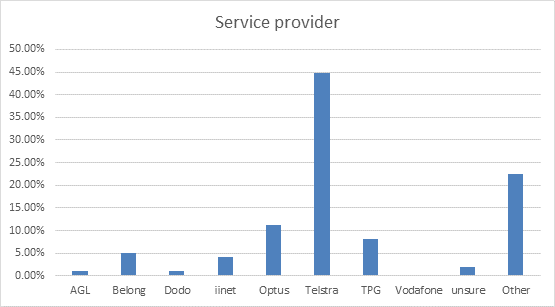
22. At
its Council Meeting on 27 May 2025, Council resolved to commence the statutory
procedures in accordance with section 115 of the Local Government Act 2020
(the Act), to undertake a community engagement process in accordance with the
Council's community engagement policy in respect to the proposal to enter into
a lease with Indara Corporation Pty Ltd; and consider any submissions on the
proposed lease at a future Planning and Consultation Committee Meeting prior to
making any final decision on whether to proceed with the lease of land to Indara
Corporation Pty Ltd.
23. Council
acknowledged and noted the submissions received from the community and any
verbal presentations made to the Committee on the lease proposal with Indara
Corporation Pty Ltd at the Planning and Consultation Committee Meeting held on
12 August 2025.
Options
24. Council
has the following options to consider concerning the lease proposal with Indara
Corporation P/L at Eltham Lower Park:
a) Resolves
to proceed with lease proposal for the terms and conditions outlined in the
Summary.
b) Resolves
to not enter into a lease with Indara Corporation P/L for the area shown in Attachment
1 and request that Indara Corporation provide an alternative location in
Eltham Lower Park.
c) Resolves
to not enter into a lease with Indara Corporation P/L for the area shown in Attachment
1 and Eltham Lower Park is not further considered for telecommunications
infrastructure.
25. After
considering and hearing submissions in response to the lease proposal with
Indara Corporation P/L, it is recommended that Council does not proceed with
the lease proposal, on the terms and conditions as outlined in the Summary.
26. Council
remains committed to addressing the telecommunications blackspot in this area
to ensure our community has reliable connectivity, while also safeguarding the
unique natural environment. Council is supportive of Indara continuing to work
with officers to further assess and review options, and to present an
alternative solution for telecommunications infrastructure, whether within
Eltham Lower Park or at another suitable nearby location, that balances
improved service with strong environmental protection.
27. Any
further proposal by Indara will require internal assessment and Council endorsement
prior to undertaking a community engagement process.
28. If
Indara choose to provide Council with an alternative option, they will be
required to choose a location which is further distance from Hohnes Hills
Reserve than the proposed lease site in Attachment 1, to address
community concerns around the environmental impact to the Eltham Copper
Butterfly.
Council plans and policies
29. This
report directly supports the achievement of the Council Plan 2021-2025
strategy:
· We
act in the best interests of our community.
Access, Equity and Inclusion
30. Not
applicable.
Sustainability implications
31. During
the community consultation period following concerns raised by community about
the Eltham Copper Butterfly, Council’s Environmental Works and Land
Management team provided a summary of feedback from an environmental
perspective.
32. It
is recommended that the applicant consider a response in its application for
the proposed infrastructure taking into account the following environmental
considerations:
a. Concerns
were raised that the existing sports field light currently only comes on during
certain times e.g. winter nights when there is an activity going on at the oval
and that the new lights will be on all the time potentially affecting the
population of the ECB species at Hohnes Hill. Eltham Lower Park and adjacent
Hohnes Hill Reserve have high biodiversity values, including nationally
threatened flora and fauna (including presence of the Nationally Critically
Endangered Matted Flax-lily within 100m of the proposal, Connectivity to the
Birrarung (Yarra River) and Diamond Creek habitat corridors.)
b. The
proposal may impact endangered species (e.g., Matted Flax-lily, Swift Parrot,
Eltham Copper Butterfly, Clover Glycine) and native vegetation.
c. The
proposal may trigger Commonwealth and State environmental legislation (Environment
Protection and Biodiversity Conservation (EPBC) Act Flora and Fauna Guarantee
Act, Native Vegetation Regulations).
d. Consideration
of potential tree canopy loss and options to retain tree canopy where
appropriate.
Leasing and Planning stages
33. Council
as land manager is currently considering the lease proposal with Indara,
however if this were to proceed Indara/Downer are still required to meet
relevant planning requirements and approvals in order to construct the
telecommunications infrastructure in Eltham Lower Park. This process would
include:
a. Council
considering and resolving to enter into a lease with Indara;
b. Council receiving Minister or their delegate responsible
for the Crown Land (Reserves Act) 1978 Grant and Purpose
Approval for the lease and then the final agreement (terms and conditions
approval);
c. Downer/Indara
submitting a planning application to Council and receiving approval; and
d. Downer/Indara
submitting an application form for DEECA Land Owner Consent For Use and
Development of Crown Land. This must include a letter of support from Nillumbik
Council as the appointed Committee of Management. This is assessed by DEECA
environmental officers.
34. If
Indara/Downer does not receive planning approval then the lease would not be
deemed valid.
35. Although
initial planning advice forms part of the leasing assessment and consideration,
the Planning assessment and approval is a separate process, which is undertaken
by Indara/Downer if Council agrees to enter into a lease with Indara.
36. Downer/Indara
are unable to submit a planning application until Council provides land manager
consent.
37. DEECA
also needs to provide Land Owner Consent to any proposed works before the works
are undertaken within Eltham Lower Park. The proposed works are assessed by
DEECA Environmental Planning Area.
38. The
lease is subject to Indara receiving any applicable planning approvals for the
new telecommunications infrastructure, as well as DEECA landowner
consent.
Planning overlays and permit for telecommunication infrastructure
within Eltham Lower Park:
39. As
noted above Indara/Downer will be required to ensure all relevant permits and
approvals have been provided prior to undertaking any works.
40. Council
as the responsible authority reviews planning applications for
telecommunications facilities through a separate process under the Planning
and Environment Act 1987.
41. The
following would be considered when assessing the requirements for
telecommunications infrastructure in Eltham Lower Park:
a. Clause
19.03-4L of the Nillumbik Planning Scheme, being ‘Telecommunications in
Nillumbik’ should be considered with regard to telecommunications
infrastructure in Eltham Lower Park, this includes:
· Encourage
the screening of telecommunication facilities (especially towers and poles) in
rural areas, particularly in locations that are visually prominent.
· Site
telecommunication facilities so that biodiversity and the landscape and
environmental values of rural areas are protected.
b. The
park is zoned Public Park and Recreation Zone (PPRZ) and accordingly the
purpose of this zoning is:
· To
recognise areas for public recreation and open space.
· To
protect and conserve areas of significance where appropriate.
· To
provide for commercial uses where appropriate.
c. The
park is affected by the Environmental Significance Overlay Schedule 1 noting
the purpose of this overlay is:
· To
identify areas where the development of land may be affected by environmental
constraints.
· To
ensure that development is compatible with identified environmental values.
The
environmental objective to be achieved under the Environmental Significance
Overlay Schedule 1, is to protect and enhance regional and strategic habit
links, including sites of faunal and habitat significance identified in
‘Sites of Faunal and Habitat Significance in North-east Melbourne
(Beardsell 1997)’. Indara (Downer) will need to address in its
planning application the impact to the Eltham Copper Butterfly which is
referenced in the aforementioned report, as a species listed under the Flora
and Fauna Guarantee Act.
d. Sections
of Eltham Lower Park land are covered by the Cultural
Heritage Significance (overlay) mapping. It would be the responsibility of
Indara (Downer) to satisfy Council’s Planning Department that a CHMP is
not required, usually by engaging with a Cultural Heritage consultant during
the planning application stage.
e. The
park also has a Bushfire Management Overlay and areas of land subject to
Inundation Overlay, which would also be considered when Indara (Downer) apply
for a planning permit.
42. Downer
are proposing the location as shown in Attachment 1, as the proposed
monopole infrastructure will have minimal ground impact on the land as it is
being swapped over for existing sporting oval light pole, however works will
need to occur where the cabinet is to be located including vegetation may need
to be removed where the equipment cabinet is to be located and a retaining wall
built. This is subject to Downer’s final detailed design.
43. Planning
have conducted a preliminary review of the proposed plan provided by Downer and
advised by virtue of Clause 52.19 -1 of the Nillumbik Planning Scheme a
planning permit will be required as the cabin and light pole are located within
an Environmental Significance Overlay (ESO1) and cannot be determined as a low
impact facility as specified in the Telecommunications (Low-impact Facilities)
Determination 2018 (Cth).
44. The
removal or trimming of existing trees is only noted on the proposed (draft)
plans (Attachment 1) as “TBC”, however Council would require
an assessment of the trees impacted to understand whether there are any
planning permit requirements for the tree works. Planning permission may be
required under the ESO1 and Clause 52.17 (Native Vegetation) planning controls.
45. When
Downer submits a planning application the requirement to advertise the
application is normally determined by the planning officer after a site
inspection in terms of whether there would be any loss of amenity by the
installation of the tower. Based on the plans provided by Downer it is
likely that Planning would advertise the application as it will be located in a
public area.
46. Anyone
can make a submission to a planning application once it's lodged with Council,
also at any point up until Council makes a decision on the application (which
can be some time after the advertising period).
47. Essentially
the notification/advertising period is done to make sure that anyone affected
is made aware of the application.
48. Downer
have been requested to complete a pre-application meeting so that their
proposed plans can be discussed with a Planner. Through this process, it is
recommended that the applicant have regard to addressing the environmental
feedback noted above.
Officer comment in response to considering other site
options:
49. Downer
approached multiple other candidates before proceeding with this location,
including two in Bolton Street shops and a few locations within Eltham Lower
Park.
50. As
the telecommunications cabinet needs to be close to the telecommunications
monopole, this had to be taken into account when considering which light pole
around the oval was most suitable.
51. Downer
approached Council with a few other options within Eltham Lower Park, however
these areas were not feasible following assessment by Council officers and
Downer representatives for a number of reasons, including the impact to other
areas within the park (including oval, cricket nets, car parking, more impact
to vegetation) and more underground wiring across further distances within the
park (easements) which could cause more long term problems and ground
disturbance.
52. In
2024, Downer provided Council officers with a few other site locations within
Eltham Lower Park. These locations were assessed and considered by Council
officers, and Downer and Indara representatives at an onsite visit to Eltham
Lower Park and determined to not be suitable, these locations included:
a) Site
near pavilion and cricket nets (north of existing site – shown by yellow
marker)
There are existing assets within
the ground (drainage), although maybe still possible for additional
infrastructure.
At the onsite inspection, the
Downer team found there was not sufficient space to complete the construction
of the facility with the playing fields being in such close proximity.
It is approximately 102m from
Hohnes Hill Reserve, which is one of the six bushlands reserves for the
conservation of the Eltham Copper Butterfly in Nillumbik.
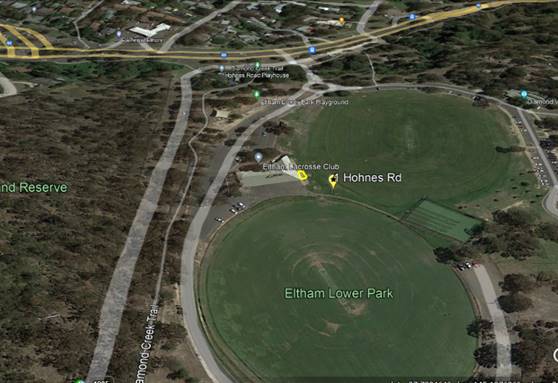
b) Light
pole near cricket nets
Concerns existing area used for
driveway and car park may need to be upgraded in time. Previous Recreation and
Leisure Manager advised of scar tree in area.
If cabinet located here limits
area for cars.
Further distance for cabling,
which means more ground disturbance along entrance driveway (depends on final
plans by Downer) and AusNet approval.
This site is closer to the river
(approximately 150m), so may raise more concerns about the impact to the
environment.
This part of the land at Eltham
Lower Park is an area of cultural heritage sensitivity.
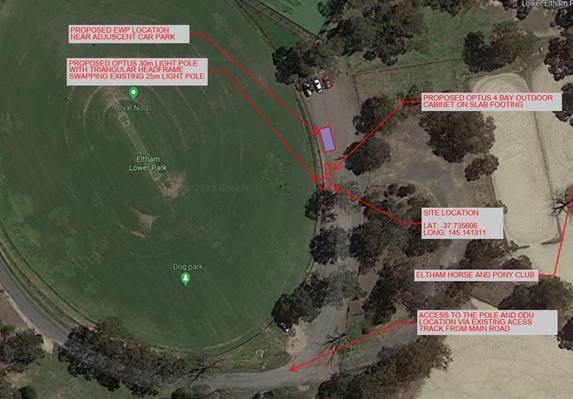
Increase in lighting
53. Indara’s
proposed plan does not increase lighting in the area, it only reinstates the
existing sports field lighting to the monopole. This light would only come on
at the existing times with the other sports field lights.
Downer’s response around potential effects of
radiation to humans and insects
54. As
part of Downers work, they complete a search of the EPBC protected matters
database for all proposed sites. To obtain council planning approval Downer
will review the proposed location to identify any matters of national
environmental significance under the EPBC Act.
55. If
any issues are flagged Downer and Indara will engage a qualified ecologist to
confirm there will be no impact on the species or habitat as part of the EPBC
Act.
56. The
ecology report does not assess radiofrequency electromagnetic energy (RF EME)
impacts to insects including the Eltham Copper Butterfly, the ecologist report
addresses earthworks and direct disturbance to the environment.
57. Telecommunication
facilities are bound by the rules that Australian regulatory agency ARPANSA
(Australian Radiation Protection & Nuclear Safety Agency) set. The ARPANSA
RF Standard is intended for protecting humans against the known harmful effects
of exposure to radiofrequency electromagnetic energy (RF EME) and does not
specifically consider protection of flora and fauna in its principles. However,
existing studies on the effects of the low-level RF EME exposure on plants and
animals indicate that the exposure limits set within the Standard are adequate
in providing protection to the environment.
Refer to: https://www.arpansa.gov.au/regulation-and-licensing/regulatory-publications/radiation-protection-series/codes-and-standards/rpss-1-qa#the-environment-animals-and-plants.
58. Telecommunications
towers generally have a minimal impact on wildlife, particularly when they are
carefully planned and sited to avoid environmental risks. These facilities
typically require a small footprint, causing limited land disturbance and reducing
disruption to wildlife habitats. By placing them on previously disturbed land
or near existing infrastructure, such as buildings, the need for land clearing
is minimised, ensuring that larger areas of native vegetation or wildlife
corridors remain intact.
59. Downer
has provided the attached Factsheet on Mobile Telephone Base Stations and
Health to support their infrastructure in this public area, refer to Attachment
5. This Fact Sheet is in relation to human health.
Downer’s response to black spot and colocation by
Telstra:
60. Downer
have advised that Indara are aware that Telstra is also looking into a new
proposal in the area which would indicate they also have issues with coverage
in this same area. Attachment 4 shows existing nearby towers and the
carriers.
61. Telecommunication
carriers can and do commonly share structures. In this case Indara are a
neutral host and offer colocation opportunities to all telco carriers. For this
particular site Telstra have approached Indara for the feasibility of Telstra
co-locating and the structure will be designed to hold both Optus and Telstra
assets if Telstra do intend on co-locating.
62. The
plan shown on page 3 of Attachment 4, shows the “black spot”
areas where there is lack of Optus signal in the area and how this will be
improved with the proposed new telecommunication infrastructure.
Officer comment - Other approvals
63. Eltham
Lower Park is Crown land located at 570-576 Main Road, Eltham, being Crown
Allotment 6G Township of Eltham, Parish of Nillumbik, which Council is
Committee of Management.
64. Any
lease or licence for Committee of Management land requires the relevant
Minister or their delegates to consent to the proposed lease terms and
conditions (Grant and Purpose Approval) and then the final agreement (terms and
conditions approval).
65. Initial
advice from DEECA’s Environmental Planning area has been that as the
Indara new infrastructure will require ground disturbance and is a new use it
will require landowner consent for the works to occur. An application for Land
Owner Consent For Use and Development of Crown Land form should be completed by
the proponent (Downer) and include a letter of support from Nillumbik Council
as the appointed Committee of Management.
Officer comment in response to rental amount and reviews:
66. Council’s
practice in negotiating commercial leases is to engage a qualified external
valuer to assess and complete a formal market rental valuation prior to
commencing negotiations on key lease terms and conditions, although there is no
legal requirement for Council to obtain a market rental valuation prior to
granting a lease of Council owned or managed premises under the Local
Government Act 2020.
67. Council
considers the Local Government Best Practice Guidelines for the Sale and
Exchange of Land dated June 2009, which extends to cover leasing.
68. As
Council manages the Land on behalf of DEECA, Council is obligated to complete
market valuations for commercial tenants to determine the market rent.
69. Council’s
external valuer, Matheson Stephen Valuations (MSV) has completed an assessment
of the market rent for this lease proposal and confirmed by a certificate of
valuation that the market rent is $25,000 net of GST and outgoings, this takes
into account the above and underground infrastructure connecting the site to
the main road; and Eltham is a prime location.
70. MSV
advised that there is not enough evidence of rent increasing due to colocation
for them to provide a market rental fee in the event that Indara have more than
one carrier (Optus & Telstra etc) utilising their infrastructure. Under the
lease Indara will be responsible for all infrastructure, compliance,
maintenance and upgrades. The way in which they manage colocation is ultimately
their responsibility.
71. MSV
considered similar lease proposals and existing leases for similar
infrastructure on public land managed by Victorian Councils, including Yarra
Ranges and Merri-bek.
72. Council’s
lawyers have advised that Local Government Professionals (LGPro’s)
position was that Tenants can bring on carriers (Telstra, Optus etc) without
Landlord consent and uplift in rent. Council still however has the option to
consider negotiating a lease with an uplift in rent if more than one carrier,
although this maybe a difficult to negotiate given that it is becoming less
common practice.
Community engagement
73. The
leasing of Council land is subject to the requirements of Section 115 of the Local
Government Act 2020, which requires Council to undertake a community
engagement process in accordance with the Council's community engagement policy
in respect of the lease proposal if the proposed lease is over 10 years or the
rent is over $100,000 per annum.
74. As
this lease proposal involves new telecommunications infrastructure on public
land, it is appropriate for Council to engage with
its community on the matter.
75. Community
engagement on the leasing proposal commenced Friday 30 May to Sunday 22 June
2025.
76. Consultation
took the form of a survey on Council’s Participate Nillumbik site https://participate.nillumbik.vic.gov.au.
77. The
consultation was promoted through:
a) Notice
and survey on Participate Nillumbik - Have your say on the lease proposal;
b) News
release on website – explain Participate Nillumbik community engagement;
c) E-News
– June 2025 publication;
d) Email
with letter to Eltham Lower Park tenants and sports clubs (Eltham Lower Park Pavilion
and Oval);
e) Letters
to adjoining and nearby properties; and
f) The
ability to submit hard copy submissions if requested.
78. Submitters
were invited to attend the Planning and Consultation Committee to speak to
their submission.
Innovation and continuous improvement
79. Council
has committed through the Green Wedge Management Plan 2019 to advocate for
improved internet access and mobile phone coverage. This proposal provides an
opportunity for Council to improve coverage for residents, businesses and
emergency services within Eltham.
Collaboration
80. Internal
consultation has been completed with a number of teams and feedback was
provided by Recreation and Leisure, Economic Development and Tourism,
Amenities, Traffic and Transport, Capital Works, and Strategic Planning. These
areas of Council preferred that if telecommunications infrastructure is to be
erected in Eltham Lower Park it is located as indicated in Attachment 1.
Council’s Environmental team provided further feedback after the internal
consultation process which is outlined above.
81. Communications
and Economic Development and Tourism have previously completed work and
community engagement on black spot areas within the Shire, which supports this
lease proposal in Eltham.
Budget considerations
82. Costs
associated with the lease proposal have been accounted for in the Governance
and Property Department operational budget.
83. There
will be legal costs associated with negotiating a lease with Indara
Corporation, however Council Officers will request as part of the lease terms
and conditions that Indara pay Council’s legal fees of $3,000 plus
GST.
84. Council
will receive $25,000 per annum income from the lease, with 3% increases
annually.
Relevant law
85. Section
115 of the Local Government Act 2020, states that a Council must include any proposal to lease land in a financial year
in the budget, where the lease is—
(a) or one year or more and—
(i) the rent for any period
of the lease is $100 000 or more a year; or
(ii) the current market rental
value of the land is $100 000 or more a year; or
(b) for 10 years or more.
86. If
a Council proposes to lease land that is subject to any of the points
above and that was not included as a proposal in the budget,
the Council must undertake a community engagement process in
accordance with the Council's community engagement policy in
respect of the proposal before entering into the lease.
87. The
Crown Land Reserves Act 1978 (the Crown Land Act) enables reservation of
land for a range of public purposes, stipulates how reserved land must be dealt
with and prescribes some governance arrangements for committees of management
appointed to manage reserved land.
88. The
leasing provisions in the Crown Land Act are used to authorise a wide range of
leases for commercial and non-commercial purposes on reserved Crown land.
89. Section
17D of the Crown Land Act provides that trustees or committees of management
with the approval in writing of the Minister may enter into an Agreement to
Lease.
90. Indara
is not a licensed carrier under the Telecommunications Act 1997 and
therefore has no legal right to occupy land without a lease (or other
agreement) with Council. However, it is important to note that under Schedule 3
of the Telecommunications Act 1997, licensed telecommunication carriers
(for Low Impact Facilities) have the right to enter onto Land, including public
land, for the following purposes:
a) To
inspect the land, to determine whether the land is suitable for the
carrier’s purposes;
b) To
install a facility on the land; and
c) To
maintain facilities situated on the land.
Regional, state and national plans and policies
91. The Victorian Government is fast-tracking better
mobile coverage and broadband across the state through the $550 million Connecting
Victoria program. Victorian Government is working with
telecommunications partners to improve mobile services across Victoria between
2022 and 2026 by co-funding projects.
92. The Eltham Lower Park site has now been proposed by Optus
for Connecting Victoria funding.
Conflicts of interest
93. All
officers involved in the preparation of this report have made a declaration
that they do not have a conflict of interest in the subject matter of this
report.
Council Meeting Agenda 30
September 2025
12. Officers'
reports
Distribution: Public
Manager: Blaga
Naumoski, Director Governance, Communications and Community Safety
Author: Michele
Purtle, Manager Advocacy Communications and Engagement
Summary
This report provides a strategic
overview of Council’s advocacy activities and recommends a refreshed
approach to strengthen Nillumbik’s capacity to influence government
policy and secure external funding. It outlines the current advocacy approach,
examines the changing political and funding landscape, and proposes a more
coordinated and forward-looking strategy. Central to this is resetting
Council’s advocacy platform to reflect evolving community needs and to
leverage emerging opportunities in the lead-up to future State and Federal
elections.
To achieve this, the report seeks
Council endorsement on the establishment of an Advocacy Framework and four-year
Action Plan to guide Council’s advocacy efforts and presents a draft set
of 2025–2026 advocacy priorities for Council’s consideration.
|
That Council:
1. Endorses
the Advocacy Framework (Attachment 1).
2. Endorses
the 2025–2026 Advocacy Priorities (Attachment 2).
3. Endorses
the four-year Advocacy Action Plan (Attachment 3) and requests
officers commence implementation of the Action Plan.
4. Requests
officers to progress early advocacy initiatives aligned with the adopted
2025–2026 Advocacy Priorities, including the identification and
preparation of suitable projects for upcoming State and Federal budget
processes and election commitments.
|
Attachments
|
1 . .
|
Attachment 1 - Advocacy
Framework
|
|
2.
|
Attachment 2 - Advocacy
Action Plan
|
|
3.
|
Attachment 3 -
2025-2026 Advocacy Priorities
|
Discussion
1. Advocating
on the community’s behalf is a key responsibility of Council. The
majority of our advocacy is directed to the State and Federal Governments to:
· Receive financial investment from the State or Federal Government
for delivery of infrastructure or services; or
· Influence policy reform or a change in legislation.
This report sets
out to achieve the following:
· Outlines Council’s current approach to advocacy and explores
the shifting landscape that is influencing Nillumbik’s funding
opportunities.
· Proposes the development of an Advocacy Framework and accompanying
four-year Action Plan to provide strategic direction and consistency in future
advocacy efforts.
· Recommends a reset of Council’s advocacy platform to ensure
alignment with the evolving needs of the community and political context.
· Presents a draft set of advocacy priorities for 2025–2026 for
Council’s consideration.
Council’s current approach to advocacy
2. Council
endorsed the current set of advocacy priorities in December 2021. A total of 23
priorities were identified and these have guided Council’s approach to
advocacy in the lead up to State and Federal elections and annual pre-budget
opportunities.
3. The
priorities were informed by community feedback in various forums, including the
development of the Community Vision 2040, Council Plan 2021-2025 and Health and
Wellbeing Plan.
4. These
priorities were revisited and refined in the lead up to the 2025 Federal
Election to support pre-election meetings with candidates to help secure
funding from election pledges.
Changes affecting funding opportunities
5. There
have been a number of significant changes over recent years that have impacted
funding from State and Federal Governments and reduced opportunities for
Council to financially prop up major infrastructure initiatives. These changes
include:
· The
financial landscape has undergone major change over the past three years as the
‘cost’ of COVID is felt. The cost of materials has increased the
price of delivering community infrastructure.
· Having
less funds to deliver more expensive projects has been felt at all levels of Government
and funds for new projects are limited.
· Cost
of living pressures, rate capping and new state taxes have impacted
Council’s ability to ‘top up’ state funded projects.
· The
expectation that Council will match state funding for projects limits what can
be added to our priority list or budget bids.
· More
Councils and ‘not for profit’ organisations have employed advocacy
personnel to secure funding. This makes the competition for Nillumbik even
greater.
· Traditional
advocacy methods such as email campaigns and billboard messaging are becoming
less effective in influencing politicians. In the context of increasing funding
pressures, these approaches can create challenges for MPs and may limit
opportunities for constructive discussion on community projects.
Advocacy Framework and four-year Action Plan to guide
future advocacy
6. To
be effective in our advocacy, Officers have developed an Advocacy Framework (Attachment
1) to provide the methodology and transparency around our decision-making
process. The Framework provides the foundation for how we identify community
priorities and the best approach to advocate in this changing landscape.
7. There
are many issues that Council can advocate on. To ensure that our advocacy
efforts are focussed and positioned to have the best chance for success, six principles
guide Council’s advocacy. These principles help us assess the viability
of advocacy opportunities and determine where to focus our efforts for the
greatest chance of success.
8. Our
approach is shaped by six core principles:
· Purpose – Clear ‘asks’ Advocacy is aligned with
community needs and Council’s strategic objectives.
· Evidence base – All positions are grounded in credible data,
lived experience, and research.
· Strategic and consistent – Advocacy is timely, targeted to
achieve Council objectives, and consistently reinforced across platforms.
· Equality and diversity – We advocate for outcomes that reflect
and support the full diversity of our community.
· Collaboration and partnership – We work with others to amplify
our influence and share responsibility for solutions.
· Transparency – We build trust through open, honest, and
accountable advocacy practices.
9. All
advocacy issues are important, but it is not possible to advocate at an equal
level for all issues. This is crucial for the effective use of resources and
the coordination of advocacy activities. Council will agree each year on a set
of advocacy priorities that will provide a laser sharp focus on where we will
devote our advocacy efforts. Some advocacy issues will remain a focus for
several years whereas others will be for a shorter period of time.
10. All
advocacy priorities have an identified ‘ask’ and are supported by a
sound evidence base. Fact Sheets are developed and reviewed and adjusted
annually using the advocacy principles, to ensure they are relevant, responsive
to the community and supported by current statistical data.
11. Council’s
Advocacy team will monitor and review annual state and federal budgets and
other funding opportunities and refine priorities for inclusion in pre-budget
submissions to the State and Federal Governments. Once handed down, the
government budgets will be analysed and a scorecard developed to track
investment received against Council’s priorities. This will be
summarised in a report to ELT and the community.
12. A
four-year Action Plan (Attachment 2) has also been developed that
includes four key directions designed to equip Council and the community with
more opportunities for positive outcomes to their advocacy. These include:
· Key Direction 1 – Build the community’s capacity to
advocate
· Key Direction 2 – Build the organisation’s capacity to
advocate
· Key Direction 3 – Develop partnerships for joint advocacy
· Key Direction 4 – Communicate with our
community
Resetting
Council’s advocacy platform for 2025-2026
13. To
adapt to the changing landscape, Council’s advocacy approach must pivot
from a long list of projects and adopt a more sophisticated model that responds
to how we will advocate for government investment.
14. The
proposed model supports a shorter list (no more than 10) of key priorities that
are also complemented by partnering priorities, electorate priorities and
policy positions.
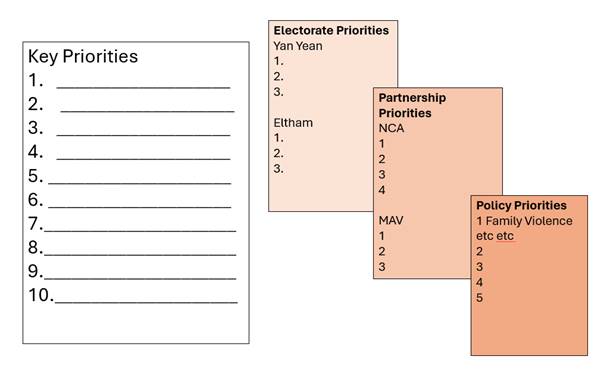
|
Key priorities
|
Less is more. Stocktake advocacy actions
that sit in strategies across the organisation and identify key priorities
that require government investment. Key priorities should have a defined
‘ask’, evidence to support why needed, an identified government
funding path and an ability for Council to match funding if applicable.
|
|
Partnering priorities
|
The Advocacy team continues to work with
the MAV, NCA, OMC, NAGA etc to actively support and influence their advocacy
programs.
When there are issues that affect Nillumbik,
the Advocacy team will proactively take on a lead role with these agencies to
roll out statewide campaigns and enable councils to come together and show
united direction on an initiative.
|
|
Electorate priorities
|
A list of smaller initiatives will be
developed for each state electorate and federal division that is included in
the municipality. Many of these projects will include initiatives from our
future capital works program which will enable Council to match funding if
needed. Having a number of ‘shovel ready’ projects available and
concept plan developed will greatly support Council’s success in
obtaining annual budget bids.
|
|
Policy positions
priorities
|
Identifying
priorities that improve the wellbeing of our residents will be advocated for
on an ongoing basis with relevant Ministers and through regional partnerships.
Ie. Family violence, mental health.
|
Projects not listed within the advocacy
model will still be actioned as they arise.
2025-2026 Advocacy Priorities
15. The
Advocacy framework has guided the development of the 2025-2026 Advocacy
Priorities (Attachment 3), with all projects assessed against the
guiding principles. Officers took a stocktake of previous advocacy priorities
along with initiatives included in the draft 2025-2029 Council Plan to compile
the 2025-2026 list.
16. The
2025-2026 includes a list of five key priorities including:
1. Upgrade
of the Greensborough Bypass / Diamond Creek Road roundabout
2. Installing
a pedestrian crossing over the Hurstbridge train line at Coolabah Reserve,
Eltham North
3. A
bus review to consider expansion of the service into the rural areas and a new
service between Diamond Creek and Mernda stations.
4. Improvements
to be included as part of the Yan Yean Road upgrade, including sealing of
Eisemans, DeFredericks and Hacketts roads in Yarrambat, virtual fencing to
protect wildlife and protection of six River Red Gums near the Bridge Inn Road
intersection.
5. Extension
of the Plenty River Trail in Greensborough to connect with the Diamond Creek
Trail in Eltham North
17. There
are five State Government electorates that represent part of Nillumbik Shire. A
list of 23 electorate projects have been matched with their
relevant electorate and Council will work with the local MP for each electorate
to consider funding opportunities.
18. Council
will continue to partner with the Municipal Association of Victoria (MAV),
Northern Councils Alliance (NCA), Outer Melbourne Councils (OMC) and other
local councils to advocate for improvements across a range of partnering
projects that benefit the sector, including pausing the glass kerbside
collection service and abandoning the Emergency Services and Volunteers Fund.
19. Council
recognises the ongoing need for access to mental health and family violence
services and the ongoing funding for bushfire preparedness and protection of
our green wedge and has included a policy position to advocate
for these at any opportunity.
Related Council decisions
20. Council
has in the past endorsed documents outlining priority items and issues on which
to advocate to Federal and State Governments in the community’s
interests.
21. Council
endorsed a suite of priorities in December 2021 to inform the State Election. A
review of these priorities was undertaken in preparation for the 2025 Federal
Election.
Options
22. Endorse
the updated 2025–2026 Advocacy Priorities (recommended)
This option reflects the
outcomes of the Councillor Briefing held on 16 September and previous engagement
with Councillors, where feedback was used to refine the advocacy priorities.
Endorsing the updated list will enable Council to position key projects for
consideration in upcoming State and Federal funding cycles, including as part
of pre-budget submissions or election commitments.
23. Defer
endorsement of the 2025–2026 Advocacy Priorities
This option would delay
Council’s ability to act on advocacy opportunities in a timely manner and
risks missing the State Government’s upcoming budget timelines. It may
also impact Council’s ability to influence emerging policy and funding
discussions in the lead-up to the next election cycle.
Council plans and policies
24. This
report directly supports the achievement of the Council Plan 2021-2025
strategy:
· We
act in the best interests of our community.
· We
source alternative and innovative funding sources to support and complement
Council services and infrastructure.
Access, Equity and Inclusion
25. Section
9 of the Gender Equality Act 2020 states Council, as a defined entity,
must conduct an Equity Impact Assessment (EIA) for policies, strategies, plans,
programs, and services that are new or up for review and have a direct and
significant impact on the public.
26. In
developing this report, the subject matter has been considered in accordance
with the requirements of the Section 9 of the Gender Equality Act 2020.
27. In
accordance with the requirements of the Section 9 of the Gender Equality Act
2020 transport, and sporting facilities, as well as public health and
wellbeing strategies relating to safety, accessibility, and inclusion. Council
acknowledges that the advocacy priorities have a gender impact and work on
these projects can address gender inequality.
28. As
such, it is required that advocacy priority project leads conduct an EIA to
ensure Council is meeting the different needs of women, men, and gender diverse
people. The associated recommendations are to be provided to ELT.
29. It
is also expected that the research from the EIA’s, including any relevant
data, community feedback and benchmarking is provided to the Advocacy Lead to
form part of Council’s evidence-based approach. any relevant data,
community feedback and benchmarking is provided to the Manager Advocacy Communications
Engagement to form part of Council’s evidence-based approach.
30. Council
is committed to promoting gender equality and will further embed Gender Impact
Assessment into selecting the advocacy priorities for 2025-2026 to ensure that
Council is addressing gender inequality across the community.
31. The
EIA process also identified that the Manager Advocacy Communications Engagement
can also play a role in promoting the need for EIAs when delivering and
reviewing Council projects.
Sustainability implications
32. The
Advocacy Priorities covers a range of policy areas, with the aim of:
a) Preserving
and enhancing the natural environment including infrastructure and activities,
climate mitigation and response and enhancing our natural amenities; and
b) Improving
the health and wellbeing of our residents through improved recreational
facilities and enhanced health and social services, programs and facilities.
Community engagement
33. The
2025-2026 Advocacy Priorities will be informed by feedback received from the community
engagement undertaken as part of the Nillumbik Now and Beyond consultation that
shaped the Council Plan.
Innovation and continuous improvement
34. Development
of the Advocacy Framework and new advocacy model are the result of reviewing
the changing economic and political landscape and refining current advocacy
practices. The 2025-2026 Advocacy Priorities will reflect current and future
community needs and the goals of the Council Plan as well as include items that
would resonate in a pre-election context.
Collaboration
35. Officers
from across Council have been heavily involved in the development of the
current priorities and helping to shape the new Council Plan. Current and new
priorities are the result of consultation with all relevant Council
departments.
Budget considerations
36. Advocacy
efforts, including the development of priorities and related advocacy
initiatives are resourced through Council’s operating budget. The new
advocacy model may require Council to agree on funding feasibility studies as
part of the evidence needed to support key priorities. Additionally, a
financial strategy may need to be proposed for projects whereby Council may
need to match government funding.
Relevant law
37. There
are no legal repercussions associated with this report.
Regional, state and national plans and policies
38. State
and Federal Government funding is tied to the policies of the respective
government in power. It is important that Council’s advocacy priorities
are considerate and aware of government policies.
Conflicts of interest
39. All
officers involved in the preparation of this report have made a declaration
that they do not have a conflict of interest in the subject matter of this
report.
Council Meeting Agenda 30
September 2025
12. Officers'
reports
Distribution: Public
Manager: Corrienne
Nichols, Director Communities
Author: Nichole
Johnson, Manager Community Partnerships
Summary
This report presents the Nillumbik Health and Wellbeing Plan
2025-2029 (the Plan) (Attachment 1) for adoption, following public
consultation and refinements in response to community feedback.
This report also presents the Annual Action Plan 2025-2026 (Attachment
2) for adoption which supports the first-year delivery of the new Nillumbik
Health and Wellbeing Plan 2025-2029 (the Plan). Reporting updates will be
received by Council on a quarterly basis, demonstrating practicable and
tangible ways the Nillumbik Health and Wellbeing Plan is delivering key health
and wellbeing outcomes for the community.
|
That Council:
1. Adopts
the Nillumbik Health and Wellbeing Plan 2025-2029 (Attachment 1).
2. Adopts
the Annual Action Plan 2025-2026 (Attachment 2).
3. Authorises
the Director Communities to make any further minor changes to the Plan and
Action Plan that may be necessary and are inconsequential in nature.
4. Publishes
the adopted Plan and Annual Action Plan 2025-2026 publicly on Council’s
website.
5. Thanks
contributors to the Plan and advises them of the outcome of the consultation
process.
|
Attachments
|
1.
|
Nillumbik Health and
Wellbeing Plan 2025-2029
|
|
2.
|
Annual Action Plan
2025-2026
|
Discussion
1. The
Nillumbik Health & Wellbeing Plan 2025–2029 has been developed in
line with Council’s legislative obligations under the Public Health
and Wellbeing Act 2008, that all Victorian councils prepare a Municipal
Public Health and Wellbeing Plan within 12 months of a new Council being
elected.
2. The
Plan also incorporates the Disability Action Plan to meet requirements under
the Disability Act 2006.
3. The
Plan is informed by:
a) A
review of local, state and national policy context
b) The
Nillumbik Community Profile 2025
c) Community
engagement through the Nillumbik Now and Beyond program
d) A
Health and Wellbeing Partnership Forum
e) A
review of the Nillumbik Health and Wellbeing Plan 2021-2025
4. The
Plan identifies six priority areas that will guide Council’s actions over
the next four years. The six priority areas are:
a) Improving
mental wellbeing and social connection
b) Preventing
discrimination and violence
c) Increasing
active living
d) Improving
food systems
e) Reducing
harm from alcohol, drugs, vaping, tobacco and gambling
f) Advocating
for and improving access to services, facilities and housing
5. The
draft Plan was publicly exhibited between 18 June and 9 July 2025, enabling the
broader community and stakeholders to review and provide feedback on the Plan.
These were considered by the Planning and Consultation Committee on 12 August
2025.
6. Submissions
reflected strong overall support for the direction and intent of the Plan.
Feedback was carefully considered, with changes incorporated into the final
plan (Attachment 1).
7. The
changes include:
a) Embedding
Council’s updated Acknowledgement of County, developed in partnership
with the Wurundjeri Woi-wurrung, as a key expression of respect and
partnership, strengthening reconciliation though its integration across
Council’s planning, programs and community initiatives.
b) Strengthening
LGBTIQA+ representation through the inclusion of local data and specific
actions in the Annual Action Plan (Attachment 2) that are focused on
inclusion, improved mental health outcomes (especially for young people),
raising visibility through recognising dates of significance, fostering
inclusive work practices and ensuing that LGBTIQA+ voices are meaningfully
included in decision making.
c) Reframing
the strategies to strengthen clarity of strategic intent, ensuring that they
articulate long-term priorities and community outcomes, with operational
details redirected to supporting action plans.
8. The
Annual Action Plan 2025-2026 (Attachment 2) has been developed
collaboratively across Council teams and in partnership with community
organisations and outline key actions which will support the delivery of the
Plan.
9. Annual
action plans enable Council to remain responsive to emerging issues, evolving
community needs, and new opportunities, ensuring initiatives remain relevant
and effective throughout the Plan’s four-year duration.
10. The
actions presented in the Annual Action Plan 2025-2026 represent key activities
only and do not encompass all Council initiatives. They provide a high-level
snapshot of the activities being undertaken to deliver on the strategies under
each health priority in the Plan.
11. It
is important to note that Council’s additional strategies and plans also
play a key role in improving health and wellbeing outcomes for the Nillumbik
community.
12. The
Annual Action Plan (Attachment 2) outlines the actions and initiatives
to be delivered in the 2025-2026 financial year, noting that delivery has been adapted
into the already adopted 2025-2026 Annual Budget.
13. A
full graphic designed version of the Plan will be available on Council’s
website following the adoption of the plan.
Related Council decisions
14. On
17 June 2025, Council endorsed the draft Nillumbik Health & Wellbeing
2025-2029 for the purposes of community consultation ending on 9 July 2025.
15. On
12 August 2025, the Planning and Consultation Committee considered a report on
the nine submissions received.
16. Council
resolved to receive and note the submissions, consider the submissions in the
finalisation of the Plan and note that a report will be presented to the 30
September 2025 Council Meeting to consider their adoption of the Plan.
Options
17. Council
adopts the Nillumbik Health and Wellbeing Plan 2025-2029 and the Annual Action
Plan 2025-2026.
Council plans and policies
18. This
report directly supports the achievement of the Council Plan 2021-2025
strategy:
· We
maintain good governance and transparency; clearly defining and communicating
the role of Councillors and Council.
· We
address the social, environmental and economic factors of health to improve
health and wellbeing outcomes for our communities.
· We
work with our local partners, government and non-government agencies to respond
to health and wellbeing priorities in Nillumbik.
Access, Equity and Inclusion
19. Council
recognises that it has an important role in creating a more fair and equitable
society by supporting, facilitating and working with the community to empower
people to have their say and help shape the future of the Shire.
20. The
development of the Plan has been guided by the principles outlined in
Council’s Access, Equity and Inclusion Policy. An equity, disability
inclusion, ageing, and gender lens has been applied to both plans.
21. Equity
Impact Assessments (EIA) have been undertaken at multiple stages of the
process, including assessments of the community engagement approaches, analysis
of data and review of the draft plans.
22. As
the Plan is delivered, officers will assess actions and conduct EIAs where
appropriate to ensure the actions are fair, inclusive and reflect the needs of
the community in line with the Gender Equality Act 2020.
Sustainability implications
23. The
Plan supports Council to act in the best interests of the community by
promoting social, environmental and economic sustainability.
24. The
Plan will guide decision-making that is realistic and achievable within
available resources, ensuring sustainable outcomes over the longer term.
Community engagement
25. Through
the Nillumbik Now and Beyond community engagement program in February and March
2025, Council sought broad community input to inform the development of the
Plan. Engagement included surveys, pop-up sessions across the Shire, workshops,
targeted outreach activities, a partnership forum and input from advisory
committees to capture diverse perspectives and experiences.
26. Together
with input from Councillors, these processes ensured the Plan was shaped by a
wide range of community voices, sector expertise, and local priorities.
Innovation and continuous improvement
27. Opportunities
for innovation and continuous improvement have been identified through the
development of the Plan and the Annual Action Plan 2025-2026, which include:
a) Alignment
of reporting timelines with the Council Plan 2025-2029
b) Improved
integration between strategic documents
c) Enhanced
integration of work between teams and community partners
d) Enhanced
engagement processes.
28. Further
opportunities are expected to emerge during implementation of the Plan with a focus
on strengthening integration across teams, fostering collaboration with
external partners, and delivering improved outcomes for the community.
Collaboration
29. Partnerships
and collaboration were central to the development of the Plan and Annual Action
Plan 2025-2026 and will remain critical to their implementation.
30. Council
will continue to work closely with other levels of government, partner
agencies, the Health and Wellbeing Advisory Committee and the community to
deliver strategies and actions.
Budget considerations
31. The
Plan is a high-level strategic document and does not make specific budget
commitments. The action plans will set out the specific actions Council will
deliver in that financial year to progress the objectives and strategies of
each plan.
32. Where
gaps exist in resources or new opportunities for initiatives are presented,
additional budget or grant funding opportunities may be sought.
Relevant law
33. The
Public Health and Wellbeing Act 2008, requires Council to prepare and
adopt a Municipal Public Health and Wellbeing Plan within 12 months of a
general election.
34. The
Gender Equality Act 2020 requires defined entities, including councils,
to take positive action towards achieving workplace gender equality and to
consider gender equality in their policies, programs, and services.
35. The
Disability Act 2006 provides a framework for enabling the rights,
inclusion, and participation of people with disability in the community. It
guides Council to remove barriers, improve accessibility, and ensure our
services, facilities, and programs are inclusive and responsive to the needs of
people with disability.
36. The
Climate Change Act 2017 provides a framework for reducing
climate-related risks and building community resilience. It guides Council to
mitigate environmental health impacts, strengthen adaptation and support
healthier, more sustainable environments.
Regional, state and national plans and policies
37. A
number of local, state and national plans have been considered when developing
the Plan including the Victorian Public Health and Wellbeing Plan 2023–2027.
Conflicts of interest
38. All
officers involved in the preparation of this report have made a declaration
that they do not have a conflict of interest in the subject matter of this
report.
THIS PAGE WAS LEFT INTENTIONALLY BLANK
Council Meeting Agenda 30
September 2025
12. Officers'
reports
Distribution: Public
Manager: Jeremy
Livingston, Director Culture and Performance
Author: Robert
Malignaggi, Acting Chief Financial Officer
Summary
This report presents the Asset Plan 2025-2035 (Attachment
1) for adoption, following public consultation, receipt of submissions and
refinements to the plan in response to the submissions received.
The Asset Plan is a requirement under section 92 of the Local
Government Act 2020 and must be adopted by 31 October 2025. The Asset
Plan provides a high level strategic and financial view of how Council intends
to manage its transport, building, drainage and open space assets over the next
ten (10) financial years.
The Asset Plan 2025-2035 was subject to public exhibition
and community consultation between 18 June to 9 July 2025. At its meeting on 12
August 2025, the Planning and Consultation Committee considered a report
outlining the four written submissions received. The Committee did not hear any
verbal submissions.
Having considered the feedback from
the written and verbal submissions, some refinements to the Asset Plan have
been made, and these are documented in this report.
|
That Council:
1. Adopts
the Asset Plan 2025-2035 (Attachment 1)
containing amendments and suggestions in response to the submissions received
following public consultation.
2. Authorises
the Director Culture and Performance to update legislative and Council
requirements listed in the Asset Plan 2025–2035 which may occur over
the life of the Asset Plan.
3. Makes a copy of the
adopted Asset Plan 2025–2035 publicly available on Council’s
website.
4. Thanks submitters and
advises them of the outcome of the consultation process.
|
Attachments
|
1.
|
Attachment 1 - Asset
Plan 2025-2035
|
Discussion
1. Council
is required to adopt the Asset Plan 2025-2035 prior to 31 October 2025, under
section 92 of the Local Government Act 2020. The Asset Plan has effect
from 1 July 2025.
2. The
scope of the Asset Plan is for the next ten year period, 2025-2035.
3. The
Asset Plan is a high-level strategic document, with financial projections
aligned with Council’s Financial Plan 2025-2035.
4. The
Asset Plan has been prepared in compliance with the Local Government Act
2020.
5. The
Draft Asset Plan 2025-2035 was publicly exhibited for 21 days. Four submissions
were received.
6. Minor
changes have been made to the Asset Plan following the community feedback, which
are now included in the final version of the plan (Attachment 1).
7. These
changes include:
· The
wording in the requirements section for the Eltham Lower Park Masterplan has
been updated to include passive users alongside other park stakeholders.
· Rewording
impact of services for:
o Buildings category, demand
driver: population change
o Drainage
category, demand driver: climate change
o Drainage
category, demand driver: cultural change
o Drainage
category, demand driver: demand for increased services
in areas where drainage is not currently provided
o Open
Space category, demand driver: increased female
participation and gender diversity in sports
o Open Space category,
demand driver: population growth.
Related Council decisions
8. Prior
to the introduction of Section 92 of the Local Government Act 2020,
there was no requirement on Council to adopt an Asset Plan. On 28 June 2022, Council
adopted the first Asset Plan (2022-2032) under Section 92 of the Act.
9. On
17 June 2025, Council endorsed the Draft Asset Plan 2025-2035 for the purposes
of community consultation ending on 9 July 2025.
10. On
12 August 2025, the Planning and Consultation Committee considered a report on
the four submissions received in response to the Draft Asset Plan. There were
no verbal presentations to the Committee on the Asset Plan.
11. The
Committee resolved to note the submissions received, consider those submissions
in the finalisation of the Asset Plan, and note that a report will be presented
to the 30 September 2025 Council Meeting to consider its adoption.
Options
12. Adopt
the Asset Plan 2025–2035.
Council plans and policies
13. This
report directly supports the achievement of the Council Plan 2021-2025
strategy:
· We
carefully protect, plan, maintain and improve open spaces, streetscapes and
places to ensure that they are safe, accessible and enjoyable.
Access, Equity and Inclusion
14. The
Asset Plan considers accessibility within the Levels of Service, Legislative
and Council Requirements and also within the Future Demand section along with
gender diversity and participation in sports.
Community engagement
15. The
Draft Asset Plan was the subject of a public consultation period from 18 June
– 9 July 2025 where community members and groups had the opportunity to
provide their feedback.
16. The
Planning and Consultation Committee considered a report outlining the four
written submissions received. At the Committee meeting on 12 August 2025, the
Committee did not hear any verbal submissions.
Innovation and continuous improvement
17. The
Asset Plan has also been designed as a digitally interactive document, allowing
exploration of the data behind the decision-making processes. This innovative
approach presents the information in a dynamic and user-friendly manner that
could be made available through Council’s website following its
endorsement.
Collaboration
18. As
part of the development of the Asset Plan 2025-2035, consultation occurred
across relevant teams within Council. They are listed below;
· Capital and
Infrastructure
· Finance,
Assets and Procurement
· Operations
Centre
· Recreation
and Leisure.
Budget considerations
19. The
Asset Plan is a high-level strategic document, with financial projections aligned
with Council’s Financial Plan 2025-2035.
Relevant law
20. This
Asset Plan follows the requirements of section 92 of the Local Government
Act 2020, which states Council must develop, adopt and keep in force
an Asset Plan that has an outlook of at least 10 years.
21. The
Asset Plan must include:
a) Information
about maintenance, renewal, acquisition, expansion, upgrade, disposal and
decommissioning of each class of infrastructure under its control and outline
any other resource requirements considered appropriate.
b) The
Plan has a longer-term outlook (10+ years). It provides a view (both strategic
and in financial terms) of how the Council proposes to manage the whole
portfolio of assets that it owns and controls.
Regional, state and national plans and policies
22. Not
applicable.
Conflicts of interest
23. Officers
who have been involved in the preparation of this report declare that they do
not have a conflict of interest in the subject matter of this report.
Council Meeting Agenda 30
September 2025
12. Officers'
reports
Distribution: Public
Manager: Jeremy
Livingston, Director Culture and Performance
Author: Robert
Malignaggi, Acting Chief Financial Officer
Summary
This report presents the Financial Plan 2025–2035 (Attachment
1) for adoption, following public consultation, receipt of submissions and
refinements to the plan in response to the submissions received.
The purpose of the Financial Plan is to demonstrate
Council's financial sustainability in order to fund the aspirations of the
Community Vision and the Council Plan.
The Financial Plan has been prepared in compliance with the Local
Government Act 2020, the Department of Jobs, Precincts and Regions’
Financial Plan Better Practice Guide and model, and the Australia Accounting
Standards Board accounting standards.
The information and community feedback gathered through the
‘Nillumbik Now and Beyond’ community engagement program has been
considered throughout the development of the Financial Plan.
The Financial Plan 2025– 2035 was subject to public
exhibition and community consultation between 18 June to 9 July 2025. At its
meeting on 12 August 2025, the Planning and Consultation Committee considered a
report outlining the four written submissions received. The Committee did not
hear any verbal submissions.
Having considered the feedback from the written and verbal
submissions, some minor refinements to the Financial Plan have been made, and
these are documented in this report.
|
That Council
1. Adopts
the Financial Plan 2025–2035 (Attachment 1).
2. Authorises the Director
Culture and Performance to make any further minor changes to the Financial
Plan that may be necessary and are inconsequential in nature.
3. Makes
a copy of the adopted Financial Plan 2025–2035 publicly available on
Council’s website.
4. Thanks
submitters and advises them of the outcome of the consultation process.
|
Attachments
|
1 . .
|
Financial Plan
2025-2035
|
Discussion
1. Council
is required to adopt the Financial Plan 2025-2035 prior to 31 October 2025,
under section 91 of the Local Government Act 2020. The Financial Plan
takes effect from 1 July 2025.
2. The
scope of the Financial Plan is for the next ten-year period 2025-2035.
3. The
Financial Plan provides the context through which the objectives of the Council
Plan can be funded in order to achieve the Community Vision. The Financial Plan
includes financial statements outlining the financial resources required to
give effect to the Council Plan and contains information about the decisions
and assumptions that underpin the forecasts in the statements.
4. The
Financial Plan has been prepared in compliance with the Local Government Act
2020, the Department of Jobs, Precincts and Regions’ Financial
Plan Better Practice Guide and model, and the Australia Accounting Standards
Board accounting standards.
5. The
information and community feedback gathered through the ‘Nillumbik Now
and Beyond’ community engagement program has been considered throughout
the development of the Financial Plan.
6. The
Draft Financial Plan 2025-2035 was publicly exhibited for 21 days. Four
submissions were received.
7. Minor
changes have been made to the Financial Plan following the community feedback,
which are now included in the final version of the plan (Attachment 1).
8. Specifically,
an appendix has been added which provides a more detailed overview of key
assumptions applied in the Financial Plan.
Related Council decisions
9. On
17 June 2025, Council endorsed the Draft Financial Plan 2025-2035 for the
purposes of community consultation ending on 9 July 2025.
10. On
12 August 2025, the Planning and Consultation Committee considered a report on
the four submissions received in response to the Draft Financial Plan. There
were no verbal presentations to the Committee on the plan.
11. The
Committee resolved to note the submissions received, consider those submissions
in the finalisation of the Financial Plan, and note that a report will be
presented to the 30 September 2025 Council Meeting to consider its adoption.
Options
12. Adopt
the Financial Plan 2025-2035.
Council plans and policies
13. The
Financial Plan directly supports the achievement of the Council Plan 2025-2029.
Access, Equity and Inclusion
14. Not
applicable.
Sustainability implications
15. Council’s
financial sustainability is informed by the indicators set by the Victorian
Auditor General’s Office (VAGO).
16. These
indicators comprise of both short term and longer term measures. The indicators
are calculated and considered as part of the budget process.
Community engagement
17. Through
the ‘Nillumbik Now and Beyond’ community engagement initiative,
feedback was received which was considered in developing the draft Financial
Plan.
18. The
Draft Financial Plan was the subject of a public consultation period from 18
June – 9 July 2025 where community members and groups had the opportunity
to provide their feedback.
19. The
Planning and Consultation Committee considered a report outlining the four
written submissions received. At the Committee meeting on 12 August 2025, the
Committee did not hear any verbal submissions.
Innovation and continuous improvement
20. Not
applicable.
Collaboration
21. Not
applicable.
Budget considerations
22. This
is a standard reporting item to Council, the associated costs for which are
included in the current budget.
Relevant law
23. This
Financial Plan follows the requirements of section 91 of the Local
Government Act 2020, which states Council must develop, adopt and
keep in force a Financial Plan that has an outlook of at least 10 years.
Regional, state and national plans and policies
24. Not
applicable.
Conflicts of interest
25. Officers
who have been involved in the preparation of this report declare that they do
not have a conflict of interest in the subject matter of this report.
THIS PAGE WAS LEFT INTENTIONALLY BLANK
Council Meeting Agenda 30
September 2025
12. Officers'
reports
Distribution: Public
Manager: Claire
Quinlan, Chief Operating Officer
Author: Heath
Gillett, Manager Operations Centre
Summary
Nillumbik Shire Council (Council) is
reviewing and updating its Road Management Plan, as required by the Road
Management At 2004. In accordance with these requirements Council
advertised its review on 17 July 2025 and invited submissions to the proposed
amendments.
19 submissions were received in
total.
Council’s Planning and
Consultative Committee considered these submissions at its meeting on 9
September 2025.
Having received and considered the
submissions, there are no recommendations to significantly alter the plan from
what was advertised. However, there are some minor amendments to the plan
recommended, based on further internal review of the document.
This report recommends that Council
endorses the amended Road Management Plan (Attachment 1), following the
review process.
|
That Council:
1. Adopts the Road
Management Plan 2025 as shown in Attachment 1.
2. Publishes the adopted
Road Management Plan 2025 on the Council website.
3. Advises
all submitters (that provided contact details) of the adopted Road Management
Plan 2025.
|
Attachments
|
1.
|
Road Management Plan
2025
|
|
2.
|
Road Management Plan
2021
|
|
3.
|
Submissions summary
|
Discussion
1. The
Road Management Act 2004 grants power to a road authority (Council) to
make a Road Management Plan (RMP) to establish the management system and
standards for the exercise of Council’s road management functions.
2. In
accordance with section 8 (1) of the Road Management (General) Regulations 2016
and section 90 (3) of the Local Government Act 2020, Council is required
to prepare and approve a review of its RMP by 31 October in the year following
a general election.
3. The
main purpose of the RMP is to document Council’s Road management
responsibilities, including the level of service relating to how often Council
inspects its roads and footpaths network (inspection frequency), what
Council defines as a defect / hazard (defect intervention level) and
within what timeframe Council will rectify that defect or hazard (repair
timeframe).
4. No
major changes to the consulted RMP are recommended, following the submissions
process. However, several minor amendments to the RMP, listed below, have
been recommended following further review of the document and incorporated into
the version being considered for endorsement (Attachment 1):
Layout
· Redesign
of cover page and minor formatting edits throughout the document.
Governance Table
· Populating
of ‘Guideline Governance’ and ‘Review History’ tables
on page 2.
Updated Acknowledgement of Country
· Acknowledgement
of Country updated to recently revised wording.
· Inclusion
statement added, as per Access, Equity and Inclusion Policy.
Bulk Inspections
· Addition
of statement regarding the allowance of a ‘rectification program’
to be developed, where typical response time are unable to be met, due to bulk
inspections.
Road Hierarchy Categories
· Minor
wording changes to the descriptions of ‘collector’ and
‘access’ roads.
Inspection Frequencies
· Separate
reactive inspection timeframes for vegetation clearance, as these are typically
managed by a contractor and Council has a pre-existing service level agreement.
Defect Intervention Levels and Repair Timeframes
· For
sealed roads, all timeframes listed as one week have been amended to five
working days, so that the available repair time is not reduced due to public
holidays.
· Addition
of text to clarify that vegetation pruning timeframes may be impacted where
planning permits are required.
· Error
correction in timeframe for ‘Roadside vegetation obstructing
sightlines’ for unsealed road - Cat 4, changed from four to eight weeks,
as initially intended.
· Footpath
defect time frames have been increased from 4 weeks, 6 weeks and 12 weeks (Cat
3, 2, 1) to 2 months 4 months and 6 months. This was due to the risk of
non-compliance with the initial timeframes, as concrete repairs often require
the use of contractors. This can require waiting for multiple jobs to
accumulate, to make it worthwhile for contractors. It is noted that the new
timeframes are still an increase in service level from RMP 2021, which were
predominantly between 6 to 12 months.
Related Council decisions
5. The
current RMP was endorsed by Council on 29 June 2021 – Adoption of Road
Management Plan 2021 (Attachment 2).
6. At
the Planning and Consultation Committee meeting on 8 July 2025, Council
resolved to give public notice of its intention to review its RMP and invite
submissions to the draft RMP (Attachment 1).
7. At
the Planning and Consultation Committee meeting on 9 September 2025, Council
noted that 19 submissions were received with respect to the review of, and
proposed updates to the Road Management Plan.
Options
8. Following
consideration of the submissions and the amended Road Management Plan, Council
can resolve to:
· Endorse
the draft RMP in its current format; or
· Propose
amendments to the RMP.
Council plans and policies
9. This
report directly supports the achievement of the Council Plan 2021-2025
strategy:
· We
continue to deliver on our road management responsibilities; working to enhance
infrastructure that aligns with the character of the neighbourhood.
Access, Equity and Inclusion
10. An
‘equity inclusion assessment’ has been undertaken as part of the
RMP review. Predominantly, the recommendations of the assessment relate to:
· Acknowledgement
of Country and flags in relevant documents related to consultation promotion
and socialisation of the RMP.
· Engagement
with relevant sections of the community
· Use
of plain language and consideration for translation services
11. Officers
presented the RMP to the Inclusion and Access Advisory Committee on
27 June 2025. Notice of the submissions period was also included in the
minutes of the meeting and the disability inclusion e-newsletter.
Sustainability implications
12. The
RMP covers Council’s level of service for footpaths and shared / bicycle
pathways, promoting social and environmental sustainability.
13. The
RMP enables Council to pursue economic sustainability, by being central to a
policy defence for public liability claims relating to the road and footpath
network.
Community engagement
14. The
communications plan for the RMP has involved an online page on Participate
Nillumbik, with promotion of the engagement via social media and E-newsletters,
with the opportunity to provide feedback on the draft. This has included a
summary of the proposed changes being made to this plan.
15. In
accordance with section 54(5) of the Road Management Act 2004 Council
gave public notice (via The Age newspaper and the Government Gazette) on 17
July 2025, of its intention to conduct a review of the RMP.
16. The
public were invited to make a submission within 28 days of the notice. As per
the communications plan, this was also advertised on the Participate Nillumbik
page, along with social media and E-newsletters.
17. The
submissions period concluded on 15 August 2025, and 19 submissions were
received.
18. Council
considered the submissions to the committee at the Planning and Consultation
Committee meeting on 9 September 2025.
19. A
summary of the submissions received, during the formal consultation period and
the officer response can be seen in Attachment 3.
20. Updates
to the relevant Nillumbik webpages are also proposed to support community
understanding of the RMP.
Innovation and continuous improvement
21. The
review process for Council’s RMP embraces a continuous improvement
philosophy.
22. A
review of Council’s RMP is performed every four years.
23. The
2025 version of Council’s RMP will be the sixth iteration of this plan.
With each iteration, Council refines its level of service and one of the
benefits of this is building in efficiencies gained through program and process
improvement
Collaboration
24. The
review of the current RMP has involved collaboration between the Roads team
and:
· Traffic
and Transport
· Risk
and Safety
· Parks
and Open Space
· Assets
· Planning
and Environment
· Recreation
and Leisure
· Community
Programs
· Capital
and Infrastructure.
Budget considerations
25. Proposed
changes have been reviewed by the responsible teams and are not anticipated to
result in any change to internal resourcing requirements.
Relevant law
26. The
Road Management Act 2004 grants power to a road authority (Council) to
make a Road Management Plan (RMP) to establish the management system and
standards for the exercise of Council’s Road management functions.
27. In
accordance with section 301(3) of the Road Management (General) Regulations
2016 and section 90 (3) of the Local Government Act 2020, Council is
required to prepare and approve a review of its RMP by 31 October in the year
following a general election.
Regional, state and national plans and policies
28. Not
applicable.
Conflicts of interest
29. All officers involved in the preparation of this
report, have made a declaration that they do not have a conflict of interest in
the subject matter of this report.
THIS PAGE WAS LEFT INTENTIONALLY BLANK
Council Meeting Agenda 30
September 2025
12. Officers'
reports
Distribution: Public
Manager: Claire
Quinlan, Chief Operating Officer
Author: Stewart
Broussard, Manager Recreation and Leisure
Summary
The purpose of this report is to seek
approval to consult on the BMX Jumps and Community Recreation Park concept plan
(Attachment 1).
Community consultation on the community
recreation park is proposed to commence on 1 October 2025 and conclude on 21
October 2025. Submissions received during this period will be considered by the
Planning and Consultation Committee on 11 November 2025.
Community will be given the
opportunity to speak to their submission at the Planning and Consultation meeting
on 11 November 2025.
|
That Council:
1. Endorses
the attached BMX Jumps and Community Recreation Park Concept Plan for the
purpose of community consultation.
2. Approves
Council officers to undertake community consultation for the period of 1 October
2025 to 21 October 2025, inviting written submissions for the BMX Jumps and
Community Recreation Park in line with the endorsed concept plan.
3. Considers
all public submissions at the Planning and Consultation Committee meeting to
be held on 11 November 2025.
|
Attachments
|
1 . .
|
BMX Jumps and Community
Recreation Park Concept Plan
|
Discussion
1. In
November 2021, Council resolved to initiate investigations into BMX and
off-road biking opportunities across the Shire, and to actively pursue external
funding for future project initiatives.
2. Between
late 2021 and throughout 2022, Council undertook extensive community
consultation regarding BMX and off-road biking opportunities near the Diamond
Creek Trail on Allendale Road. Feedback gathered during this process directly
informed the planning and design stages, resulting in a final BMX jumps layout
shaped by community input.
3. In
October 2022, Council secured $2,163,424 in funding from the State Government
through the Growing Suburbs Fund (GSF). Council also committed a contribution
of $650,000 towards the project.
4. The
BMX Jumps and Community Recreation Park project was initially planned for
construction at 145 Allendale Road, Diamond Creek. However, due to Cultural
Heritage requirements and flood level implications, the project could not
proceed at this location.
5. At
the Council Meeting on 27 May 2025, Council endorsed Challenger Street Reserve
as the new site for the BMX Jumps and Community Recreation Park project.
6. Following
the change in location, the BMX Jumps design was adapted to suit the new site
by mirroring the original layout to accommodate existing trees. This adjustment
ensures that no trees will be removed and positions the beginner runs adjacent
to the ‘learn-to-ride’ track, enhancing both safety and integration.
7. Whilst
the design intent is not changing, consideration is being given to surface
finish type. Two options have been identified:
a) Natural
compacted dirt finish
i) The
jumps would need to remain covered with tarps when not in use. This would also
result in limited use during winter.
ii) Users
would be required to uncover and lightly hose the jumps before riding to
protect their integrity. This helps bind the surface, ensures the lips are
firm, provides a consistent launch, and slows deterioration.
iii) After
each session, users would be required to re-shape the jumps to maintain their
structure and design. A light hose and re-covering with tarps would also be
necessary at the end of use.
iv) Regular
maintenance would be required to undertake more substantial reshaping and
repairs.
v) There
is potential to establish a community-led volunteer Committee of Management or
Friends of group to support education, engagement, and participation in ongoing
maintenance activities.
b) Sealed
surface finish
i) Consideration
is being given to the application of a sealed finish of the dirt jumps known as
‘Sic Surface’. Sic Surface is a durable, weatherproof polymer
aggregate coating.
ii) Use
of this product could decrease ongoing maintenance costs and resources by up to
75%.
iii) This
surface type does not require covering when not in use, nor does it require
pre- or post-use maintenance.
iv) This
option would not require a community-led volunteer Committee of Management or
Friends of group to maintain the site.
8. To
enhance the user’s experience and support the use of the BMX Jumps, a
community recreation park will be built around the jumps.
9. A
concept plan has been developed that features:
a) Disabled
car park and drop off area
b) Toilet
facilities – minimum one DDA compliant toilet
c) 1.8m
concrete path connection
d) Learn-to-ride
‘pump-track’
e) Shelters
f) Bike
racks and bicycle repair station
g) Bench
seating at various locations throughout the activity site
h) BBQ
i) Waste
Bins
j) Water
fountain stations
k) Safety
lighting at car park and toilet facilities
l) Vegetation
and tree planting.
10. The
recreation park has been designed to cater for the wider community by:
a) Ensuring
the site is accessible and offers amenities for all community members
b) Giving
new or younger riders the facilities required to learn how to ride the jumps
c) Providing
necessary facilities to support ‘long stays’ such as toilets,
seating and shelter
d) Providing
necessary features to create a safe, enjoyable community space including water
fountain stations, waste bins, BBQ and landscaping.
11. Council
will seek feedback on the concept plan through a community consultation
process.
Related Council decisions
12. At
the Council Meeting on 27 May 2025, Council endorsed Challenger Street Reserve
as the new site selection for the BMX dirt jumps and Community Recreation Park
project.
Options
13. Undertake
community consultation on the attached concept plan for the period 1 October
2025 – 21 October 2025.
Council plans and policies
14. This
report directly supports the achievement of the Council Plan 2021-2025
strategy:
· We
facilitate participation in sports, leisure and recreational activities.
Access, Equity and Inclusion
15. The
recreation park concept plan incorporates Universal Design Principals.
16. An
Equity Impact Assessment has been completed and will be reviewed at key stages
of the project to ensure the project delivers an inclusive space that meets the
diverse needs of the community.
Sustainability implications
17. The
activity area sits outside the Land Subject to Inundation Overlay (LSIO).
18. The
activity area is outside the area of Cultural Sensitivity. A heritage
consultant has provided formal advice that the project would be exempt from a mandatory
Cultural Heritage Management Plan (CHMP).
19. Challenger
Street Reserve is a highly valued environmental site. The design addresses this
by including fencing around high valued areas and other environmental
initiatives.
20. Protection
measures for high value vegetation and the existing wetlands will be
incorporated in a site-specific Environmental Management Plan which will be
developed prior to construction.
Community engagement
21. Community
consultation will be undertaken 1 October 2025 – 21 October 2025 via
Participate Nillumbik to capture community feedback.
22. The
consultation will outline the components of the concept plan that cannot be
influenced by the community, such as;
a) Project
activity area
b) BMX
jumps design
c) Environmental
protection features
d) Inclusion
of funding agreement deliverables:
i) DDA
compliant toilet
ii) Amenities
and pathways
iii) Seating
iv) Learn
to-ride track
v) Car
parking
vi) Vegetation
and tree planting
vii) Safety
lighting.
23. The
project consultation page will include a questionnaire that will provide
community with the opportunity to influence:
a) Preference
on BMX Jumps surface (sealed or compacted dirt), including;
i) Information
regarding conditions of use for BMX jumps constructed from compacted dirt
ii) Opportunity
to express interest in joining a community-led group to help maintain the jumps
b) Location
of toilets
c) Location
of BBQ
d) Quantity
and location of seats
e) Quantity
and location of shelters
f) Quantity
and location of water fountain stations
g) Quantity
and location of bins
h) How
users will travel to and access the site.
24. Community
will be given the opportunity to speak to their submission at the Planning and
Consultation Committee Meeting on 11 November 2025.
Innovation and continuous improvement
25. Consideration
is being given to the application of a sealed finish of the dirt jumps known as
‘Sic Surface’. Sic Surface is a durable, weatherproof polymer
aggregate coating. Use of this product could decrease ongoing maintenance costs
and resources by up to 75%.
Collaboration
26. The
concept design incorporates feedback from internal stakeholders, including the
Environment & Sustainability and Parks & Open Space teams, and draws on
learnings from similar projects experienced by the consulting designers.
Budget considerations
27. The
project is jointly funded with the State Government, with Council receiving
$2,163,424 through the Growing Suburbs Fund and committing an additional
$650,000.
Relevant law
28. Not
applicable
Regional, state and national plans and policies
29. Not
applicable
Conflicts of interest
30. All
officers involved in the preparation of this report have made a declaration
that they do not have a conflict of interest in the subject matter of this
report
THIS PAGE WAS LEFT INTENTIONALLY BLANK
Council Meeting Agenda 30
September 2025
12. Officers'
reports
Distribution: Public
Manager: Jeremy
Livingston, Director Culture and Performance
Author: Robert
Malignaggi, Acting Chief Financial Officer
Summary
Under Section 108 (5) of the Local Government Act 2020,
Council is required to undertake a review of its Procurement Policy at least
once during each four-year term.
The current version of the Procurement Policy 2021-2025 was
adopted by Council in June 2021. The current policy was developed in
collaboration with the Northern Council Alliance in compliance with the Local
Government Act 2020.
The review of the current policy has been undertaken by
Council’s procurement officers and the Chief Financial Officer.
The updated
Procurement Policy was presented to the Audit and Risk Committee on
1 September 2025.
The updated Procurement Policy (Attachment 1) is
presented to Council for endorsement.
|
That Council:
1. Adopts the Procurement Policy
2025-2029 (Attachment 1).
2. Makes the Procurement
Policy available on Council’s website.
|
Attachments
|
1.
|
Attachment 1 -
Procurement Policy 2025-2029
|
|
2 . .
|
Attachment 2 - Summary
of updates to Procurement Policy 2025-2029
|
Discussion
1. Following
a detailed review, an updated Procurement Policy is presented to Council for
endorsement (Attachment 1).
2. Section
108(5) of the Local Government Act 2020 (the Act) requires councils to
have a Procurement Policy, and at least once during each four-year term of
Council, review and amend the policy.
3. The
Act requires that the Procurement Policy must:
· include
the principles, processes and procedures applying in respect of the purchase of
goods and services by Council, including for carrying out of works; and
· seek
to promote open and fair competition and provide value for money.
4. Under the Act, a Procurement Policy must include the
following:
· the
contract value above which Council must invite a tender or seek an expression
of interest;
· a
description of the criteria to be used by Council to evaluate whether a
proposed contract provides value for money;
· a
description of how Council will seek collaboration with other councils and
public bodies in the procurement of goods or services;
· the
conditions under which Council may purchase goods or services without inviting
a public tender or expression of interest; and
· a
description of the process to be undertaken in inviting a public tender or
expression of interest.
5. The
current Procurement Policy was adopted by Council in June 2021. The policy was
developed in collaboration with the Northern Council Alliance (NCA) in
compliance with the Local Government Act 2020.
6. The
policy is structured as follows:
· Body
of policy Sections 1-5 are compliance aspects common to the NCA councils and
have been adopted by all of the NCA councils.
· Appendices
hold Council specific information and these can be changed as required any
time.
7. Any
required changes to Sections 1-5 require a collaborative review by the NCA
Procurement Leads and NCA Council resolutions to adopt changes.
8. The
amendments that have been made are specific to Nillumbik Shire Council and are
managed via appendices that are unique for Nillumbik Shire Council, and do not
apply to the other NCA councils.
9. The
review of the current policy has been undertaken by Council’s procurement
officers and the Chief Financial Officer, and subsequent minor amendments are
proposed.
10. The
full list of the proposed amendments is provided in Attachment 2.
11. A
summary of the proposed minor changes are as follows:
· New
and updated definitions included to provide additional clarity
· Minor
changes to existing clauses to ensure clear and consistent application
· Wording
update to ensure flexibility in the case of natural disaster and emergencies.
· Appendices
update to provide broader guidelines governing contract variations
· New
clauses necessary in the context of emerging priorities and issues.
Related Council decisions
12. The
current version of the Procurement Policy was adopted by Council at the June
2021 Council Meeting.
Council plans and policies
13. This
report directly supports the achievement of the Council Plan 2021-2025
strategies:
· We
continue to exercise sustainable and responsible financial management.
Access, Equity and Inclusion
14. Gender
equality is addressed in the policy, with tenderers needing to demonstrate how
they are promoting gender equality in their practices.
Sustainability implications
15. The
policy seeks to drive sustainability outcomes through procurement processes.
Community engagement
16. Not
applicable.
Innovation and continuous improvement
17. The
regional Procurement Policy developed by the NCA Procurement Leads was the
first complete regional group policy developed by Councils in Victoria.
Collaboration
18. The
updated Procurement Policy as presented to Council’s Audit and Risk
Committee on 1 September 2025. The Committee recommended the inclusion of
broader guidance for governing contract variations.
Budget considerations
19. The
review and update of the Procurement Policy has no direct budget implications.
Relevant law
20. Section
108 of the Local Government Act 2020.
Regional, state and national plans and policies
21. Not
applicable.
Conflicts of interest
22. All
officers involved in the preparation of this report have made a declaration that
they do not have a conflict of interest in the subject matter of this report.
THIS PAGE WAS LEFT INTENTIONALLY BLANK
Council Meeting Agenda 30
September 2025
12. Officers'
reports
Distribution: Public
Manager: Jeremy
Livingston, Director Culture and Performance
Author: Robert
Malignaggi, Acting Chief Financial Officer
Summary
This report presents an
updated Investment Policy and new Loan and Borrowing Policy for Council’s
endorsement.
Council’s Investment
Policy provides guidance for the investment of Council’s cash holdings.
The policy takes a conservative approach to investment, in accordance with the
requirements section 103 of the Local Government Act 2020. Updates
include references to the Local Government Act 2020, review of
counterparty limits and a more detailed consideration of investment priorities.
Council’s Loan and Borrowing Policy is a new policy, to
provide Councillors and officers with a framework of underling principles to
consider when making decisions and undertaking borrowing processes.
|
That Council:
1. Endorses the updated Investment Policy (Attachment
1).
2. Endorses the new Loan and Borrowing
Policy (Attachment 2).
|
Attachments
|
1.
|
Investment Policy
|
|
2.
|
Loan and Borrowing
Policy
|
Discussion
Investment Policy
1. Council
invests cash with authorised deposit-taking institutions (banks) in accordance
with the provisions of the Local Government Act 2020.
2. Council
holds cash for purposes which do not always require immediate expenditure (for
example, developer contributions that will be used to fund future
infrastructure works). Investments are made through term deposits for periods
of up to one year.
3. Council’s
Investment Policy provides guidance for cash investments, taking account of the
credit rating of each bank, and also the interest rate.
4. The
updated Investment Policy (Attachment 1) addresses the following:
a) Purpose
and legislative scope
b) Investment
objectives
c) Portfolio
implementation
d) Investment
guidelines
e) Reporting
on investments
f) Review
of policy.
5. Council takes a conservative approach to cash investment. This is
consistent with the requirements of the Local Government Act 2020
(section 103) which restricts Council’s to low-risk investments.
6. The
policy stipulates that preservation of capital shall be the principal objective
of Council’s investment.
7. Risk
is minimised in two ways through the policy:
a) By
restricting the amount that can be invested with any individual bank, according
to the credit rating of that bank. This is known as the Counterparty Limit in
the policy. Spreading Council’s investments across multiple banks assists
Council to minimise the level of risk.
b) By
restricting the cumulative amount that can be invested in banks that have
particular credit ratings. The better the credit rating, the greater the
proportion of funds that can be invested with banks in that category.
8. Subject
to these two conditions being satisfied, the policy then seeks the highest
interest rate available through quotations from banks, with preference then
given to institutions fully divested of fossil fuel investment.
9. Minor
changes have been made to the individual counterparty limit, increasing the
amount that can be invested with any single A-1+ rated institution to 75%
(previously 50%). This will increase Council’s ability to maximise
investment returns across government guaranteed institutions.
Loan and Borrowing Policy
10. Section
104 of the Local Government Act 2020 mandates Council cannot borrow
money unless the proposed borrowing is included in either the budget or a
revised budget.
11. To
ensure best practice, good governance and financial prudence is consistently
applied, councils should develop and adopt a Loan and Borrowing Policy.
12. The
policy promotes financial sustainability, and provides a framework for
responsible and sustainable loan debt management.
13. The
policy promotes transparency and accountability, through establishing clear
decision-making processes around when and why to borrow.
14. The
intention of the policy is also to supports the principles of good governance
by ensuring borrowing is justified, disclosed, and regularly monitored.
15. Within
the context of the rate-capped environment, the policy enables Council to fund
critical infrastructure projects where up-front funding is not available or
financially prudent.
16. The
policy promotes intergenerational equity – spreading the cost of assets
over the life of the asset, so current and future users share the burden
fairly.
17. A
risk management framework is established within the policy through controls around debt
levels, interest rate exposure, and repayment schedules.
18. The
Loan and Borrowing Policy (Attachment 2) addresses the following:
a) Purpose
and legislative scope
b) Scope
and objectives
c) Limits
and risk indicators
d) Principles
and structure
e) Monitoring
and reporting
f) Roles
and responsibilities
g) Review
of policy.
Related Council decisions
19. Not
applicable.
Options
20. Not
applicable.
Council plans and policies
21. This
report directly supports the achievement of the Council Plan 2021-2025 strategies:
· We continue
to exercise sustainable and responsible financial management.
Access, Equity and Inclusion
22. Not
applicable.
Sustainability implications
23. Not
applicable.
Community engagement
24. Not
applicable.
Innovation and continuous improvement
25. Continuous
improvement and innovation opportunities identified have been considered as
part of the review of the Investment Policy and preparation of the Loan and
Borrowing Policy.
Collaboration
26. The
policies were presented to the Audit and Risk Committee in September 2025.
Budget considerations
27. Investment
income is an important revenue source for Council.
28. Borrowings
must be included and endorsed within the budget for the period in which the
loan is to be drawn upon.
Relevant law
29. Local
Government Act 2020.
Regional, state and national plans and policies
30. Not
applicable.
Conflicts of interest
31. All
officers involved in the preparation of this report have made a declaration
that they do not have a conflict of interest in the subject matter of this
report.
Council Meeting Agenda 30
September 2025
12. Officers'
reports
Distribution: Public
Manager: Frank
Vassilacos, Director Planning, Environment and Strategy
Author: Amanda
Kern, Manager Strategic Planning, Transport and Environment
Summary
This report seeks to
progress Planning Scheme Amendments C143nill (Eltham Major Activity Centre) and
C144nill (Diamond Creek Major Activity Centre), which implement the adopted
2020 Structure Plans for both activity centres into the Nillumbik Planning
Scheme.
Amendment C143nill
(Eltham) has been split into two parts:
· Part
A – Eltham Town Centre
· Part
B – Bridge Street Business Area (BSBA), where further work is required to
address economic development opportunities and potential land contamination in
the existing Industrial Precinct.
For Amendment C144nill
(Diamond Creek), officers recommend that unresolved submissions be referred to
an independent Planning Panel for review.
The Structure Plans
were adopted in 2020 and the associated amendments were exhibited for community
feedback in June–July 2024. Fourteen (14) submissions were received
(seven for each centre). Council has considered the feedback, made changes
where appropriate, and recommend referring remaining unresolved matters for
Diamond Creek to a Planning Panel to ensure transparency. This includes the
proposed removal of notice and review exemptions.
The Structure Plans do
not propose major changes to the built form or character of either centre. Key
elements include:
· Maintaining
existing building height limits (3–5 storeys).
· Improving
public spaces through clearer design controls.
· Enhancing
transparency and participation by removing exemptions from notice and review.
Overall, the current planning provisions are
considered appropriate to guide development and growth in both centres over the
next 5–10 years. This includes to satisfactorily accommodate demand
for future dwellings in response to the Housing Targets which stipulate the
need for 6,500 new dwellings across the Shire by 2051.
|
That Council:
1. Progresses Planning
Scheme Amendments C143nill and C144nill to implement the Eltham and Diamond
Creek Activity Centre Structure Plans into the Nillumbik Planning Scheme by:
a) Resolving
to split amendment C143nill (Eltham MAC) into Part A and Part B.
b) Resolving
to adopt C143nill - Part A (as in Attachment 1) and submit to the
Minister for Planning, pursuant to Section 23 of the Planning and
Environment Act 1987.
c) Resolving
to delay Part B (as in Attachment 2) to enable further work, pursuant
to Section 23 of the Planning and Environment Act 1987.
d) Resolving
to refer C144nill (Diamond Creek MAC) (as in Attachment 3) to an
independent Planning Panel to deal with unresolved submissions (as in Attachment
4), pursuant to Section 23 of the Planning and Environment Act 1987.
|
Attachments
|
1.
|
C143nill Eltham MAC -
Part A Ordinance
|
|
2.
|
C143nill Eltham MAC -
Part B Ordinance
|
|
3.
|
C144nill Diamond Creek
MAC Ordinance
|
|
4.
|
Submissions Response
Table
|
Discussion
Amendment Background
1. The Eltham and Diamond Creek MAC Structure Plans were adopted by
Council in 2020, following two years of comprehensive background research and
extensive community consultation. Every Council in Victoria is required to
complete structure plans for their respective Major Activity Centers (MAC) to
ensure long-term orderly planning.
2. The
adopted structure plans provide improvements to urban design, pedestrian
experience, landscaping and advocates to the State government for transport
improvements, among other matters. The Eltham and Diamond Creek structure plans
are available on Council's website.
3. In
addition to implementing the adopted structure plans, the proposed amendments
largely provide updates and improvements to the settings for modest growth
already applied by the Nillumbik Planning Scheme since 2014. For example, the
amendments do not:
a) Alter
the fact that, since 2014, the height limit applied in each centre has been 3
to 5 storeys (10.5 to 17.5 metres); and
b) Increase
the land area in each activity centre available for commercial/industrial
activity or medium density housing.
4. The
amendments also initially set out to apply the Activity Centre Zone (ACZ) to
the Bridge Street Business Area (BSBA) / Industrial precinct (precincts 10, 11
and 12) in Eltham (no longer the case, see section 17 for more on this), and
remove the exemptions from notice and review in both activity centres to
provide the community with more transparency and an opportunity to participate
in planning matters.
Authorisation of amendment from Minister for Planning
5. Following
Council adoption, Council staff sought authorisation from the
Minister for Planning (the Minister) to prepare the Amendments.
6. Authorisation
to prepare the Amendments was delayed due to subsequent changes to Ministerial
Directions on Form and Content, requiring significant redrafting of amendment
materials.
7. Council
received authorisation for each amendment and publicly exhibited both together from
6 June 2024 via Participate Nillumbik.
Notifying the community
8. Pursuant
to the statutory requirements of the P&E Act,
Section 19, Council mailed 1,015 letters on 31 May 2024 to owners and occupiers
within and directly abutting the Eltham and Diamond Creek MACs. Affected
authorities, Prescribed Ministers, and the broader community were also notified
through various channels.
9. Public
exhibition of the amendments commenced on 6 June 2024 to 19 July 2024 via
Council’s Participate Nillumbik webpage, with amendment materials also
available at the customer service desk. Notifications were sent to followers of
the webpage, surrounding Councils, Traditional Owner Groups, local MPs, and
community groups.
Submissions received
10. Collectively,
14 submissions were received for both centres (seven each).
11. C143nill
(Eltham MAC): Seven submissions received — 2 requesting changes and
the remainder in support, no objections. Key changes included:
a) The
Environment Protection Authority (EPA) seeking Council to make a determination
on whether there is potentially contaminated land in the BSBA / Industrial area,
and whether land uses are impacted by this (unresolved –
proposing to split this out of the current Amendment and address this as a
separate process).
b) Resident
group seeking clearer language and residential precinct setbacks (resolved).
12. C144nill
(Diamond Creek MAC): Seven submissions received – one requesting
changes and one objection. The remainder are in support. Key themes / changes
include:
a) Resolve
a VicTrack zoning anomaly along rail line (resolved).
b) Objection
to removing exemptions from notice and review. This objection is unresolved
and will be referred to an independent Planning Panel.
13. Item
12b above refers to the current control which does not require applications in
the centre to be advertised or third parties to appeal to VCAT unless height
limits or setbacks are exceeded in an application for building and works.
Council is seeking to change this to enable advertising for all applications
and to enable third parties (the community) to appeal to VCAT if they feel
necessary. This is to maintain and improve public participation in the planning
process.
14. Council
officers have revised the amendment material, where appropriate, to address
requested changes from submissions. Not all requested changes were able to be
resolved. Officers have engaged directly with submitters and objectors in an
effort to reach common ground (Refer to Attachment 4 for Council’s
response to all submissions).
15. Under
the P&E Act Council must consider all submissions and decide whether:
a) to
change the amendment,
b) refer
it to a panel (if submissions cannot be resolved), or
c) abandon
it in full or in part (e.g., if an issue raised required further work).
16. Note: At the 6 August 2024
Council Briefing (post-exhibition), officers recommended pausing the amendments
following the release of draft housing targets under the State
Government’s emerging Plan
for Victoria. Officers highlighted potential implications for
existing and draft strategic work, including the MAC Structure Plans, and
sought DTP’s agreement to pause the process in light of this uncertainty
and the upcoming caretaker period. On 23 December 2024, DTP provided in-principle
support to proceed, noting the amendments had already been exhibited.
Splitting amendment C143nill (Eltham MAC)
17. Following
the EPA’s submission regarding potential contamination in the BSBA,
officers undertook a desktop review of historical land uses in accordance with
Planning Practice Note 30 (PPN30).
18. This
review sought to identify properties in the BSBA with a high risk of
contamination, however the information available was inconclusive and therefore
the EPAs submission cannot be resolved.
19. Ministerial
Direction 1 and PPN30 require Council to ensure that sensitive and other uses
(e.g. retail, office, open space) are not exposed to contamination without
appropriate investigations such as environmental audits or risk screening.
20. Without
conclusive evidence of contamination, to manage risks, and to maintain the
integrity of the amendment process, officers recommend splitting Amendment
C143nill into two parts:
a) Part
A – Eltham Town Centre, to proceed to adoption; and,
b) 
Part B – BSBA, to be delayed at this stage, to allow further
investigation.
21. Furthermore,
in the period following COVID-19, the Eltham Town Centre has experienced
increased vacancies. Further work is needed to better understand these economic
impacts and ensure the vitality of the town centre is not compromised.
Additional analysis of market demand and land supply in the BSBA is also
required.
22. This
staged approach allows improvements in the Eltham Town Centre to proceed, while
deferring changes to the BSBA until issues relating to land contamination and
economic development are more comprehensively understood and can be addressed
appropriately.
23. While
this will delay rezoning for some landowners, Council has a duty under the Environment
Protection Act 2017 to respond where there is a reasonable belief that land
may be contaminated.
24. This
approach is consistent with Sections 23 and 29 of the Planning and
Environment Act 1987, which allow an amendment to be adopted (or abandoned)
in parts.
25. Amendment
C144 (Diamond Creek) will proceed separately to a Planning Panel to address an
unresolved submission regarding notice and review exemptions.
Strategic justification for progressing the amendments
26. Despite
the issues raised during exhibition, the amendments will deliver clearer, more
enforceable built form controls that strengthen the character of the MACs and
reduce the risk of VCAT disputes. They also support greater housing and
economic diversity in Nillumbik.
27. The
amendments implement Council’s adopted 2020 Structure Plans, which remain
current and relevant, being only midway through their intended 10-year
lifespan.
28. Council
is now confident that recent State planning reforms and housing targets have
minimal impact on these amendments.
29. The
existing planning provisions within both centres are considered appropriate to
accommodate any immediate development demand and can accommodate initial
dwelling demand to fulfil the 6,500 new dwelling target imposed by the State
Government, if needed.
30. Significant
time and resources have already been invested in the development of these
amendments. Reworking or delaying them in response to evolving policy settings
would be inefficient and place unnecessary financial strain on Council.
Related Council decisions
31. At
the 22 March 2022 Council Meeting, Council resolved to:
a) Requests
the Minister for Planning, under Section 8A of the Planning and Environment Act
1987, to authorise the preparation and exhibition of Amendments C143 and C144
to the Nillumbik Shire Planning Scheme, as detailed in Attachments 1-8.
b) On
receipt of that authorisation, places Amendments C143 and C144 to the Nillumbik
Planning Scheme on exhibition.
Options
32. It
is recommended that C143nill (Eltham MAC) be split into Part A –
Eltham Town Centre (Attachment 1) and Part B – BSBA (Attachment
2), and that Council delay Part B pending further work. Part A is
recommended for adoption.
33. It
is recommended that amendment C144nill (Diamond Creek MAC – Attachment
3) proceed to a Planning Panel to ensure the community are provided an
opportunity to review the changes requested for the amendment, and that a Panel
provide its direction on the appropriateness of those changes.
34. Officers
note that these amendments are due to lapse in June 2026. If an amendment
lapses, all progress is lost and the amendment can no longer continue. An
extension may be requested from the Minister for Planning, however, approval is
not guaranteed.
Council plans and policies
35. This
report directly supports action 2f of the Council Plan 2025-2029.
Access, Equity and Inclusion
36. The preparation and exhibition of the Amendments is a
statutory requirement and a function of the Council under the Planning and
Environment Act 1987. In alignment with the Council’s Access,
Equity and Inclusion Policy and the objectives of the Act, Amendments
C143nill and C144nill have been exhibited with measures to minimise barriers to
accessing relevant information. These measures include making content available
on Participate Nillumbik and ensuring officers are accessible to discuss the
technical aspects interested parties, over the phone and in person.
Sustainability implications
37. Important
social, environmental and economic objectives are sought by the State
Government’s activity centre planning. For example, to:
a) Reduce
car dependency by consolidating housing, employment, public transport and shops
and services in close walking distance of each other.
b) Plan
for our ageing population by consolidating housing diversity in close walking
distance to shops and public transport.
c) Strengthen
the local economy by consolidating commercial activity and providing more local
employment.
d) Reflect
a preferred local character for each MAC.
e) Reduce
pressure to extend the Urban Growth Boundary (UGB) by strategically
consolidating urban development within the boundary.
Community engagement
38. Formal
notification of the Amendments took place pursuant to the requirements of the P&E Act - refer to paragraph 8 above.
39. The
community was provided a further opportunity to have their say on the
amendments at the Planning and Consultation Committee meeting on 9 September
2025.
Innovation and continuous improvement
40. The
intent of the proposed planning scheme amendments is to enhance Council’s
planning policies that guide development of the two MAC’s in the Shire.
Collaboration
41. Development
and implementation of the structure plans has and will continue to be based on
effective collaboration between relevant units within Council and with external
agencies, such as the Department of Transport and Planning (DTP) and other
government agencies.
Budget considerations
42. No
new budget is being requested at this time.
43. Funding
the administrative costs to complete the Amendment will be derived from the
existing operational budget, as approved in the 2025/2026 Council Budget.
Relevant law
44. The
P&E Act sets the
legal framework for the planning scheme amendment process and gives legal force
to Victorian planning schemes.
45. The
Environment Protection Act 2017 to set out the legislative framework for
the protection of human health and the environment from pollution and waste.
Regional, state and national plans and policies
46. Council
is required by the State Government’s planning framework to implement
Activity Centre Policy in the municipality.
Conflicts of interest
47. All
officers involved in the preparation of this report have made a declaration
that they do not have a conflict of interest in the subject matter of this
report.
THIS PAGE WAS LEFT INTENTIONALLY BLANK
Council Meeting Agenda 30
September 2025
12. Officers'
reports
Distribution: Public
Manager: Frank
Vassilacos, Director Planning, Environment and Strategy
Author: Amanda
Kern, Manager Strategic Planning, Transport and Environment
Summary
This report presents the Final Planning Scheme Review (PSR)
2025 (Attachment 1) for Council’s endorsement and outlines the changes
made to finalise the document in response to community and internal engagement.
Community engagement was conducted from 9 May 2025 to 6 June
2025, with one submission received. Submissions were presented to Council at
its 9 September Planning and Consultation Committee (PCC) meeting. In response,
relevant changes have been made to the PSR 2025, including removing reference
to buffer zones.
Overall, the findings of the Review identified that the
Nillumbik Planning Scheme was found to be operating effectively and most of the
previously identified projects and amendments in the 2019 review were
completed. Planning services and compliance work is being completed
satisfactorily and continuous improvement is having a positive impact. At the
same time, the PSR 2025 has identified opportunities to enhance and strengthen
policy objectives and required future strategic work.
The final PSR, updated with any changes as directed by
Council, will be presented to the Minister for Planning in accordance with
Section 12B(5) of the Planning and Environment Act 1987. Following
adoption, priority projects such as the Eltham and Diamond Creek Activity
Centre amendments, the Nillumbik Housing Strategy and Neighbourhood Character
Strategy will be further progressed. The priorities are also aligned to the
actions of the new Council Plan 2025-2029.
|
That Council:
1. Notes
the recent changes made to the Final Planning Scheme Review 2025 as in Attachment
5, and in response to feedback provided at the 9 September 2025 Planning
and Consultation Committee (PCC) meeting.
2. Endorses
the Planning Scheme Review 2025 (Attachment 1) and the Appendices (Attachment
2).
3. Supports
Council Officers to submit the adopted document to the Minister for Planning
in accordance with Section 12B(5) of the Planning and Environment Act
1987.
4. Authorises
the Director Planning, Environment and Strategy to make any typographical or
minor corrections to the Planning Scheme Review 2025 that may be necessary
and are inconsequential in nature.
|
Attachments
|
1.
|
Planning Scheme Review
2025 - Final
|
|
2.
|
Appendices - Planning
Scheme Review 2025 - Final
|
|
3.
|
Recommendations -
Planning Scheme Review 2025 - Final
|
|
4.
|
Submissions Response
Table - Planning Scheme Review 2025
|
|
5.
|
Summary of Changes to
Planning Scheme Review 2025
|
Discussion
Why do we need a Planning Scheme Review?
1. The
Nillumbik Planning Scheme is a legal document that applies to all land within
the Shire and is generally binding on all landowners. As the responsible
planning authority, Nillumbik Shire Council is required under Section 12B of
the Planning and Environment Act 1987 to review its planning scheme
within one year of adopting a new Council Plan. This review meets that
legislative requirement.
2. The
PSR 2025 is an audit of the planning scheme’s performance from 2019 to
2024. It aims to improve the effectiveness and efficiency of the scheme,
ensuring it addresses current local issues and aligns with state policy. The
review considers past achievements, whether the scheme is up to date, and what
future work is needed to strengthen policy and statutory planning outcomes.
3. In
line with the new Council Plan 2025-2029, the PSR 2025 sets out recommendations
to guide strategic planning work over the next four years. These
recommendations are detailed in Attachment 3.
The PSR 2025
4. The
PSR 2025 was informed by extensive background work, including analysis of
demographic and housing data, relevant Council strategies and amendments,
insights from previous consultations, planning service performance, VCAT and
Panel outcomes, and recent state and local policy changes. It also incorporates
feedback from recent community and stakeholder engagement and identifies key
planning issues and emerging themes for Nillumbik Shire.
5. Overall,
the Nillumbik Planning Scheme was found to be operating effectively and most of
the previously identified projects and amendments in the 2019 review were
completed. Planning services and compliance work is being completed
satisfactorily and continuous improvement is having a positive impact. At the
same time, the PSR 2025 has identified opportunities to enhance and strengthen
policy objectives and required future strategic work.
Submissions and changes made to the PSR
6. One
late submission was received for the PSR 2025. The submission highlighted a
number of areas for improvement (refer to Community Engagement in section
15).
7. Based
on community feedback, internal engagement, the new Council Plan 2025-2029, and
a review of the document, a number of changes have been made (as detailed in Attachment
5), as follows:
a) Inclusion
of a 25th recommendation (high priority) supporting the Council Plan
2025-29 action to explore options to prepare Environmental Sustainable
Development guidelines for Council buildings and the development community.
b) Tightening
and clarity of intention on matters concerned with conservation, the green
wedge and vegetation removal.
c) Addition
of newly identified administrative errors and anomalies in the planning scheme.
d) Removal
of actions associated with buffer zones in response to community submissions.
e) Updates
to recommendation priorities to align with actions identified in the new
Council Plan, including:
i) Preparation
of the Nillumbik Planting Guidelines priority increased from Medium to High for
better alignment with Neighbourhood Character Strategy implementation.
ii) Focusing
on conservation and clarity for prospective owners regarding Recommendation 18
– Melbourne Water Christmas Hills land divestment.
iii) Focusing
on conservation in the Green Wedge through appropriate land use and sensitive
development.
f) Removal
of any reference to future research of buffer zones.
8. The
updated recommendations are summarised below. The recommendations with greater
detail, including costing estimates and legislative requirements can be found
in Attachment 2.
|
No.
|
Recommendations
|
Priority
|
|
Housing
|
|
1.
|
Complete the Nillumbik
Housing Strategy (HS) ensuring it is updated in accordance with Plan for
Victoria.
|
High
|
|
2.
|
Implement the Nillumbik
Housing and Neighbourhood Character Strategies into the Planning
Scheme.
|
High
|
|
Heritage
|
|
3.
|
Finalise Amendment
C149nill - Heritage Review.
|
High
|
|
Integrated Water Management
|
|
4.
|
Continue to support and
collaborate with Melbourne Water on the Greater Melbourne flood modelling
project.
|
High
|
|
Vegetation and
Biodiversity
|
|
5.
|
Prepare and implement the
Nillumbik Planting Guidelines.
|
High
|
|
Environmental
Sustainable Development (ESD)
|
|
6.
|
Explore options to
develop and implement local policy for Council and the development community
to support ESD.
|
High
|
|
Activity Centres
|
|
7.
|
Finalise the Diamond
Creek Community Infrastructure Master Plan project.
|
High
|
|
8.
|
Review and progress Amendment
C143nill - Eltham Major Activity Centre Structure Plan.
|
High
|
|
9.
|
Review and progress
Amendment C144nill - Diamond Creek Major Activity Centre Structure Plan.
|
High
|
|
10.
|
Commence development of a
Hurstbridge Township Plan.
|
Med
|
|
Planning Scheme
Performance
|
|
11.
|
Review and update the
adopted Municipal Planning Strategy (MPS) having regard to Plan for Victoria
and adopted strategies including the Housing, Neighbourhood Character,
Biodiversity, Climate Action, Urban Tree Canopy strategies and Major Activity
Centre Structure Plans and implement into the planning scheme via a Planning
Scheme Amendment.
|
High
|
|
12.
|
Improve Planning and
Compliance Services through improved data collection and record
keeping.
|
Med
|
|
13.
|
Respond to the State
Government's Planning Reforms to promote sustainable and diverse housing
while ensuring the protection of Nillumbik's neighbourhood character, Green
Wedge, urban tree canopy, flora and fauna.
|
Med
|
|
Development
Contributions
|
|
14.
|
Review all Development
Contribution Plan Overlay schedules, assess accuracy and potential to provide
listed infrastructure.
|
Med
|
|
Open Space
|
|
15.
|
Commence development of a new Nillumbik
Open Space Strategy.
|
Med
|
|
Built Form and Urban
Design
|
|
16.
|
Review Design and
Development Overlays, in particular Schedules 1 and 10, and update
accordingly.
|
Med
|
|
17.
|
Review all Development
Plan Overlay schedules.
|
Med
|
|
Green Wedge
|
|
18.
|
Continue to action and
respond to Melbourne Water's Christmas Hills Land Sale project, encouraging
conservation and clarity for prospective owners.
|
Med
|
|
19.
|
Review Green Wedge
strategic policy to encourage landscape and environmental conservation through
appropriate land use and sensitive development.
|
Low
|
|
20.
|
Prepare for the next
Green Wedge Management Plan.
|
Low
|
|
Yarra River Corridor
|
|
21.
|
Review the 'waterways'
controls with the Department of Planning and Transport's waterways Planning
Practice Note.
|
Low
|
|
Advocacy & Research
|
|
22.
|
Advocate on behalf of
Council in response to State Government, Municipal and other authority plans,
strategies and policies that may affect Nillumbik Shire.
|
Low
|
|
23.
|
Research areas and topics
of interest to the Nillumbik Shire Council to ensure accurate and appropriate
strategic guidance and responses.
|
Low
|
|
Audit and Assessment of
the Planning Scheme
|
|
24.
|
Prepare an Urban Design
project focusing on fences and boundary treatments across residential areas
responding to the findings of the Neighbourhood Character Strategy.
|
Low
|
|
25.
|
Prepare a planning scheme
amendment to correct identified errors and anomalies.
|
Low
|
Next steps
9. Following
adoption, work will progress on the Housing Strategy, Neighbourhood Character
Strategy implementation, and planning scheme amendments to implement the Eltham
and Diamond Creek activity centre structure plans (recommendations 1, 2, 8 and
9). It will also enable the continuation of the Nillumbik Tree Planting
Guidelines (recommendation 5) and ongoing work with Melbourne Water to progress
the flood modelling and mapping project (recommendation 4).
Related Council decisions
10. Ordinary
Council Meeting 29 April 2025 resolved that Council endorse the Draft PSR for
the purposes of community engagement and public exhibition.
Options
11. It
is recommended that Council adopt the final PSR 2025 and submit to the Minister
for Planning in accordance with Section 12B(5) of the Planning and Environment
Act 1987 – with or without minor edits, as directed by Council.
Council plans and policies
12. This
report directly supports the implementation of key actions identified in the
new Council Plan 2025-2029.
Access, Equity and Inclusion
13. An
Equity and Inclusion Assessment (EIA) was completed and primarily recommended
that the PSR recommendations align with Health and Wellbeing priorities at the
project stage.
Sustainability implications
14. The
PSR is required to consider the economic, social, and environmental
sustainability of the municipal district, to ensure the planning scheme can
efficiently help our community achieve its sustainability goals. The project
can provide direct benefits regarding sustainability across social,
environmental, and economic outcomes.
Community engagement
15. Community
engagement was undertaken for a period of four weeks from 9 May 2025 to 6 June
2025.
16. Council
received one late submission from a community group and has responded to the
submission, making relevant changes as in Attachment 4. The submission
called for:
a) Greater
protections for agricultural land;
b) More
input and guidance for Melbourne Water’s Christmas Hills land divestment;
c) Improving
support and protection of Nillumbik’s unique biodiversity and vegetation
conservation;
d) Concern
around changes to the Urban Growth Boundary and surrounding areas;
e) Detail
for proposed Fence Guidelines;
f) Climate
change adaptation and responses;
g) Reconsideration
of future research into buffer zones.
17. On
9 September 2025 the Community was provided an additional opportunity to speak
with Council regarding the PSR 2025, with one speaker addressing Council.
As a result, further changes were made to the PSR 2025, including the removal
of reference to buffer zones.
18. Internal
consultation and engagement for the PSR 2025 included workshops with various
specialised teams.
19. To
inform the initial PSR, officers considered feedback received from previous
community engagement conducted for various projects and strategies. This
included consultation in 2024 on various strategies, including the Integrated Transport
Strategy, Biodiversity Strategy, Urban Tree Canopy Strategy and Climate Action
Plan. It also included data from the development of the new 2025-29 Council
Plan and Health and Wellbeing Plan, and feedback captured by officers over the
last four years from Councillors, officers and other stakeholders.
20. Although
the PSR is technical in nature and may be complex to interpret, it is grounded
in extensive community feedback gathered across multiple projects between 2019
and 2025.
Innovation and continuous improvement
21. Recommendations
in the PSR 2025 reflect current and future community needs and the goals of the
Council Plan 2025-2029. The PSR 2025 has demonstrated continuous improvement by
undertaking a thorough review of the planning scheme and recommending
improvements.
Collaboration
22. Council
has used guidance from the State Government to inform the methodology of the
PSR 2025.
23. The
final PSR 2025 will be presented to the Department of Transport and Planning
(DTP) and the Minister for Planning in accordance with Section 12B(5) of the Planning
and Environment Act 1987.
Budget considerations
24. The
review of the Planning Scheme has been undertaken entirely in-house by Council
officers (Strategic Planning Team).
25. Funding
to deliver the initial high-priority recommendations of the PSR will be derived
from existing budgets, as approved within the 2025/2026 Council Budget.
26. This
includes progressing the Housing Strategy, Neighbourhood Character Strategy
implementation, and planning scheme amendments to implement the Eltham and
Diamond Creek activity centre structure plans (recommendations 1, 2, 8 and 9).
27. Ongoing
PSR recommendations will be delivered through future budget requests.
Relevant law
28. Section
12B of the Planning and Environment Act 1987 requires a planning
authority to review its Planning Scheme no later than one year after the
approval of its Council Plan and report on the findings to the Minister for
Planning. The adoption of the PSR 2025 now fulfils this requirement.
Regional, state and national plans and policies
29. The
PSR 2025 has been prepared in accordance with Planning Practice Note 32: Review
of Planning Schemes and the Continuous Improvement Review Kit for Planning and
Responsible Authority.
Conflicts of interest
30. All
officers involved in the preparation of this report have made a declaration
that they do not have a conflict of interest in the subject matter of this
report.
THIS PAGE WAS LEFT INTENTIONALLY BLANK
Council Meeting Agenda 30
September 2025
12. Officers'
reports
Distribution: Public
Manager: Blaga
Naumoski, Director Governance, Communications and Community Safety
Author: Elishia
Jansz, Manager Community Safety (Municipal Recovery Manager)
Summary
The purpose of this report is to seek Council endorsement of
the Domestic Animal Management Plan 2025–2029 (DAMP 2025–2029) (Attachment
1), developed in accordance with section 68A of the Domestic Animals Act
1994.
The Domestic Animals Act 1994 requires councils to
develop and implement a Domestic Animal Management Plan (DAMP) every four
years, addressing key animal management priorities. The DAMP 2025–2029
reflects Council’s legislative obligations and incorporates updated
strategies in response to evolving community needs, consultation feedback, and
best practice across the sector.
The DAMP outlines Council’s strategic direction for
domestic animal management over the next four years, in accordance with the Domestic
Animals Act 1994, and must be adopted by October 2025. The DAMP 2025-2029 has
been developed through extensive community engagement, benchmarking with other
councils, and cross-departmental collaboration.
The DAMP 2025-2029 has been shaped by community feedback and
includes several new initiatives. Key changes proposed include a Section 25 Cat
Confinement Order, introducing 24-hour confinement with a 12-month education
and transition period before enforcement begins and a revised Section 26 Dogs
and Cats in Public Places Order, clarifying off-leash areas and dog access to
ovals when not in sporting use.
Other key elements focus on stronger enforcement of
animal-related offences, clearer guidance such as signage and definitions, and
improved education through social media, pop-ups, and partnerships with
organisations like the RSPCA. Practical measures include additional dog poo bag
dispensers and bins, more park patrols, and refined processes for issues such
as barking dogs and dog attacks. The plan also places greater emphasis on
responsible pet ownership, with initiatives to promote desexing (including
reduced-cost options).
This report also seeks Council endorsement on a new Animal
Registration Refund Policy (Attachment 4), aimed at improving fairness
principles and transparency in application of animal registration processes.
|
That Council:
1. Endorses
the Domestic Animal Management Plan 2025-2029 (Attachment 1) prepared
in accordance with section 68A of the Domestic Animals Act 1994.
2. Resolves
to make the following Order pursuant to section 25 of the Domestic Animals
Act 1994:
a) cats
within the municipality are to be confined to the owner’s property, or
the property where they are kept at all times. Cats may leave the property if
they are securely confined with an appropriate cat carrier or other
reasonable means of constraint as detailed in Attachment 2.
3. Resolves
to make the follow Orders pursuant to section 26(2) of the Domestic
Animals Act 1994:
a) prohibit
the presence of dogs (and/or cats, where relevant) in specified public
places, and/or require dogs to be on a leash in designated areas, as detailed
in the Attachment 3.
4. Maintains
mandatory desexing of cats requirement as per section 10A of Domestic
Animal Act 1994.
5. Adopts
the Animal Registration Refund Policy (Attachment 4).
6. Authorises
the Chief Executive Officer (or delegate) to:
a) give
public notice of the Orders in in Victorian Government Gazette accordance
with the requirements of the Domestic Animals Act 1994 and on Councils
Website.
b) undertake
any administrative or procedural steps necessary to bring the Orders into
effect; and
c) submit
a copy of the Domestic Animal Management Plan 2025-2029 to the Secretary of
the Department of Energy, Environment and Climate Action (DEECA) as required.
|
Attachments
|
1.
|
Domestic Animal
Management Plan 2025-2029
|
|
2.
|
Section 25 Order - Cat
Confinement
|
|
3.
|
Section 26 Order - Dog
and Cats in Public Places
|
|
4.
|
Animal Registration
Refund Policy
|
Discussion
1. The
Domestic Animals Act 1994 requires councils to develop and implement a
Domestic Animal Management Plan every four years, addressing key animal
management priorities. The Domestic Animal Management Plan 2025–2029 (DAMP
2025-2029) reflects Council’s legislative obligations and incorporates
updated strategies in response to evolving community needs, consultation
feedback, and best practice across the sector.
2. Each
theme in the DAMP is supported by defined objectives, strategic actions, and
indicators for success.
3. The
DAMP 2025–2029 has been shaped by strong community feedback, benchmarking
with other councils, and alignment with state strategies such as the Victorian
Cat Management Strategy and the RSPCA’s Rethink Roaming campaign.
4. The
two most significant policy shifts proposed are the introduction of a 24-hour
cat confinement order as referenced in Section 25 Order (Attachment 2)
and updates to the Section 26 Order relating to dog access on ovals as referenced
in Section 26 Order (Attachment 3).
5. In
addition, a range of other initiatives have been considered for inclusion,
reflecting community input and focusing on education, enforcement, and improved
facilities to support responsible pet ownership. These include:
- Implement
animal registration refund policy
- Stronger
enforcement for non-compliance with animal related offences
- Increase
targeted educational social media posts and video series
- Install
clearer signage, permitting dog on ovals outside of sporting use for specific
areas, referenced in Section 26 Order
- Provide
feedback around dog park construction and potential recommendations for
betterment
- Conduct
more pop ups, promoting responsible pet ownership
- Install
more dog poo bag dispensers and bins
- Elaborate
on definition of under effective control of a dog
- Promote
benefits of desexing cats (mandatory)
- Review
barking dog process and educate community on strategies to mitigate nuisance
barking matters
- Increase
park patrols
- Explore
initiatives for reduced cost desexing
- Improve
Council website, include information on dog attack process
- Deliver
cat containment/enclosure building sessions in conjunction with RSPCA and Cat
Protection Society.
24-Hour Cat Confinement Order
6. Should
Council resolve to introduce a 24-hour cat confinement order, a 12-month
transition period (Year 1) is proposed to allow the community time to adjust.
During this period, the focus would be on education and support rather than
enforcement.
7. Under
such an order, cats would be required to remain within the property where they
are registered. Owners would be responsible for ensuring confinement, either
through enclosures or other suitable means.
8. Council’s
existing practices, such as responding to complaints of wandering cats,
providing traps to residents, and managing impounded cats, would continue.
Currently, Council has 18 cat traps, with several typically in use at any given
time.
9. To
support the community during the transition, the following measures are proposed:
a) Provide
clear instructions with traps to ensure responsible use and animal welfare;
b) Publish
information on safe confinement practices and enclosure options on the Council
website; and
c) Explore
opportunities to partner with organisations such as the RSPCA and Cat
Protection Society to deliver workshops on cat enclosures.
10. Enforcement,
should the order be introduced, would be guided by Council’s graduated
compliance approach, combining proactive and reactive measures. This hybrid
approach enables flexibility, balances community expectations, and ensures
consistent and fair outcomes.
Changes to the Section 26 Order Relating to Dog Access on
Ovals
11. The
DAMP 2025–2029 proposes updates to the Section 26 Order to formalise
off-leash access to designated ovals when they are not in use by sporting
clubs. This responds to strong community feedback and recognises the importance
of balancing recreational use with safety and environmental considerations.
12. The
proposed changes include designating specific ovals and reserves for off-leash
use outside of sporting times, while also identifying locations where dogs will
not be permitted due to safety, use of space, or environmental reasons. Clear
and consistent on-site signage will be installed across all designated areas by
the end of Year 1 to support community understanding and compliance. Maps of
off-leash areas are included in the Draft DAMP and will transition into
Council’s upgraded POZI mapping system to provide accurate and accessible
information for the community.
13. Ongoing
monitoring, signage audits, and adherence to shared use principles will help
ensure safe and fair access to open spaces while balancing the needs of dog
owners, sporting clubs, and other community members.
Related Council decisions
14. At
Ordinary Council Meeting held on 23 November 2010 Council resolved to pursuant
to Section 10A of the Domestic Animals Act 1994, not to register any cat
after 10 April 2011 that has not been desexed or is otherwise exempt under the
Act.
15. The
current Domestic Animal Management Plan 2021-2025 (DAMP 2021-2025) was
adopted at the 30 November 2021 Council Meeting.
16. On
30 November 2021, Council resolved to adopt an existing order under s26 of the Domestic
Animals Act 1994 which made the following orders:
- Dogs must be under effective
control of a person by means of a leash no longer than three metres:
a. In
all public parks and reserves except where designated by signs in areas listed
in section (4).
b. Within five metres of a
shared use
path.
c. On
all streets, roads, public car parks and footpaths.
- Dogs and cats are not
permitted whether restrained or otherwise:
a. Within
five metres of any children’s playground or public barbeque.
b. In
environmentally sensitive areas where designated by signs (i.e. in the parks
listed below).
c. In
schools, kindergartens and childcare centres unless with the prior permission
of the Principal or Director.
- Cats are required to be
securely confined between the hours of 7.30 pm and 6 am.
- Dogs are permitted off-leash
but must be under effective control whether restrained or otherwise in the
following parks and reserves (as designated by signs):
a. Eltham
Lower Park, Eltham
b. Griffith
Park, Eltham
c. Plenty
River Drive Reserve, Greensborough
d. Eltham
East Linear Reserve north of Diosma Road, Eltham
e. Falkiner
Street Park, Eltham (Barrack Bushland)
f. Susan
Street, Eltham
g. Gumtree
Reserve, Research
h. Woodridge
Linear Park, Eltham
i. Fergusons
Paddock, Hurstbridge South side of path only: Dogs are prohibited from entering
the wetlands areas as signposted
j. Nillumbik
Park, Diamond Creek: Dogs are prohibited from entering sporting oval and
wetlands
k. Diamond
Creek Reserve, Diamond Creek: Dogs prohibited from entering wetlands areas where
signposted and sporting oval (except at Council approved events).
- As
a guide for implementation, a dog shall be deemed to be under effective control
of its owner if:
a. It
will return to its owner upon command;
b. The
owner retains a clear unobstructed view of the dog;
c. It
does not bother or worry other people or animals; and
d. It
stays within 50 metres of its owner.
- Dogs
and cats are not permitted to enter the following public places in the
following parks and reserves (as designated by signs)
a. Diamond
Creek Reserve, Diamond Creek; dogs prohibited from entering wetlands areas.
b. Sweeneys
Flats, Eltham – Parks Victoria Land.
c. Professors
Hill Reserve, North Warrandyte.
d. Chase
Reserve, North Warrandyte.
e. Blue
Tongue Bend Reserve, North Warrandyte.
f. Temple
Ridge and Bailey Gully Reserve, Wattle Glen.
g. Reserve,
Watsons Creek
h. Marngrook
Oval, Diamond Creek.
i. Coventry
Oval, Diamond Creek
j. All
sporting ovals in Hurstbridge.
- Council
may exempt any of the provisions of this Order at any time
Options
17. Officers
recommend that Council endorses the Domestic Animal Management Plan (DAMP)
2025–2029 as presented along with Section 25 cat confinement order and
Section 26 dogs and cats in public places order and maintain existing
resolution under Section 10A of the Domestic Animals Act 1994, not to
register any cat after 10 April 2011 that has not been desexed or is otherwise
exempt under the Act. Adoption as proposed ensures Council meets its statutory
obligations under the Domestic Animals Act 1994.
18. Council
could resolve to make changes to the DAMP 2025–2029 and request that a
revised version be brought back for consideration. This would extend the
adoption timeline and may require additional consultation or administrative
work.
19. Council
could choose to defer adoption of the Plan. However, this carries the risk that
Council may not meet the legislative requirement to have a DAMP adopted and
submitted to the Secretary of the Department of Jobs, Skills, Industry and
Regions by 1 October 2025. Failure to do so would result in non-compliance with
section 68A of the Domestic Animals Act 1994, exposing Council to both
regulatory scrutiny and reputational impact.
20. Council
could also choose not to adopt the DAMP. This option is not recommended as it
would place Council in clear breach of its statutory obligations under the Domestic
Animals Act 1994 and undermine the strategic management of domestic animals
across the municipality.
Council plans and policies
21. This
report directly supports the achievement of the Council Plan 2021-2025
strategy:
· We
seek to enhance community safety, public health, amenity and the environment
through improved planning and community engagement, prioritising fair and
transparent approaches to managing compliance and enforcement.
Access, Equity and Inclusion
22. Under
the Gender Equality Act 2020 the Council is required to undertake a
gender impact assessment when developing or reviewing any policy, program or
service that has a direct and significant impact on the public.
23. An
Equity Impact Assessment (EIA) has been undertaken on the community engagement
plan and recommendations formed from the assessment have been considered in the
finalisation of this plan.
24. A
further EIA has been undertaken on the Draft DAMP 2025-2029 with the following
recommendations:
· Inclusion
of an Acknowledgement of Country.
· Inclusion
of an Inclusion Statement.
· Provision
of emergency accommodation for pets to support:
o Women experiencing
gender-based violence,
o Families impacted by
family violence,
o Individuals facing
welfare concerns and other special circumstances.
· Annual
delivery of educational programs on responsible pet ownership to kindergartens
and/or schools.
· Emergency
accommodation arrangements for domestic pets and livestock during declared
emergency events.
· Off-leash
dog park maps have been designed with symbols to improve accessibility for
non-English speaking residents.
· Language
throughout the DAMP has been reviewed to:
o Avoid isolating or
marginalising members of the gender-diverse community,
o Enhance accessibility
for people for whom English is a second language.
· Authorised
Officer training to include:
o Family Violence
Awareness training.
o LGBTIQA+ Inclusion
training.
Sustainability implications
25. The
DAMP demonstrates Council’s approach to ensure that effective animal
management and responsible pet ownership is achieved in an accountable manner
that protects animal welfare, promotes education, responsible pet ownership and
encourage ways to reduce domestic animal impact on the environment, including
Council controlled land and residential properties.
26. Feedback
from the Environmental Works and Land Management and Environment &
Sustainability teams has been incorporated into the final document, supporting
Council’s Biodiversity Strategy 2024–2034.
Community engagement
27. Phase
1 of community consultation was conducted from 3 June – 14 July 2024 for
a period of 5 weeks, on Participate Nillumbik.
28. The
community and key stakeholders were invited to provide feedback and inform
Council of “Tell us, what’s important to you” with relation
to responsible pet ownership.
29. Feedback
was sought from community on a number of matters including:
· Animal
management services
· Programs
or strategies
· Review
of Councils section 26 orders relating to off leash areas and cat control.
30. This
was conducted through a survey with targeted questions to assist us to
understand community sentiment regarding animal management topics including
dogs on ovals, confinement of cats and to identify current issues that were not
included in the Domestic Animal Management Plan 2021-2025.
31. At
the end of the community consultation period, 707 submissions were
received with 2041 visits to the website and seven separate submissions
received for the Draft DAMP 2025-2029.
32. The
comprehensive insights gained from
the initial Phase 1 of community engagement was provided in the Community
Engagement Report. This informed the development of the Draft DAMP 2025-2029.
33. Phase
2 of community engagement, aimed at gathering feedback on the Draft DAMP
2025-2029 was conducted from 3 March – 4 April 2025 for a period of five
weeks, on Participate Nillumbik.
34. The
community and key stakeholders were invited to provide feedback on the Draft
DAMP 2025-2029, consultation occurred through:
· networking
· case
investigations
· pop
ups
· attendance
at dog parks
· attendance
at sporting clubs
· advertising
on corflute signage posted at dog parks
· social
media posts
· promoting
in various newsletters; and
· through
a survey with targeted questions based on the feedback received from Phase 1 of community engagement around
the community preference of dogs on or off leash on ovals outside of sporting
use and cat curfew considerations.
35. At
the conclusion of the community consultation period, a total of 524 submissions
were received in relation to the Draft DAMP 2025–2029, made up of 518
completed surveys, and 6 written submissions, with 1,640 visits to the website.
36. The
public were invited to attend the meeting of the Planning and Consultation
Committee on 13 May 2025, to speak to the item and provide further feedback to
help shape the future DAMP. There were 21 public submissions heard, providing
further feedback on the Draft DAMP.
37. Feedback
from Phase 1 and Phase 2 community consultations, together with input from the
Planning and Consultation Committee, has been used to inform the development of
the DAMP 2025–2029, as presented in this report for Council consideration.
Innovation and continuous improvement
38. Opportunities
for innovation and continuous improvement will be identified through the
implementation of the DAMP strategies.
Collaboration
39. In
developing the Draft DAMP 2025–2029, Council benchmarked with Manningham
and Whittlesea City Councils, both of which have introduced 24-hour cat
confinement orders. Key learnings included the value of a grace period to
support community adjustment, the importance of education before enforcement,
and the need for practical support measures such as access to traps and timely
officer response. Both councils have reported improved compliance and a
reduction in nuisance complaints over time.
Budget considerations
40. Costs
associated with the development of the Draft DAMP 2025-2029 and community
engagement costs have been met from existing budget allocations.
41. Council’s
current resourcing levels are sufficient to deliver all Year 1 activities,
including education campaigns and community transition support. These
activities have been costed within the existing Community Safety budget.
Importantly, enforcement of 24-hour cat confinement will not begin until Year
2, providing a full 12-month period focused on education, support, and
voluntary compliance.
42. Future
costs associated with the implementation of the Domestic Animal Management Plan
2025–2029 will be considered as part of Council’s annual budget
process. From Year 2 onwards, additional resources may be required to support
full enforcement and program expansion. These costs are expected to be partly
offset through compliance activity, introduction of a replacement fee for cat
traps, efficiency gains in service delivery, and ongoing cost recovery through
Council’s agreement with the Cat Protection Society.
Relevant law
43. Pursuant
to Section 68A of the Domestic Animals Act 1994 every Council in
Victoria is required to produce a DAMP which is renewed
every four years
44. In
addition, Nillumbik Shire Council’s General Local Law 1 holds provisions
which are relevant to this DAMP process,
including:
· Clause
29 - Collection and disposal of animal excrement
· Clause
30 - Keeping of animals
· Clause
31 – Animal buildings and cleanliness
· Clause
32 – Animal noise.
Regional, state and national plans and policies
45. Consideration
to align with comprehensive cat management framework and initiatives to be
delivered as outlined in Victorian Cat Management Strategy 2025 -2035.
46. Alignment
with RSPCA Victoria launch of new Rethink Roaming Campaign.
Conflicts of interest
47. All
officers involved in the preparation of this report have made a declaration
that they do not have a conflict of interest in the subject matter of this
report.
Council Meeting Agenda 30
September 2025
12. Officers'
reports
Distribution: Public
Manager: Jeremy
Livingston, Director Culture and Performance
Author: Daniel
Tarquinio, Manager Information Technology
Summary
This report recommends the awarding of a lease contract for
the provision of laptops and services for the existing fleet of laptop (End
User Computing) units.
The current fleet End User Computing equipment is three
years old and was acquired via a previous leasing contract term with Hewlett
Packard. The current lease arrangement in now ending and the existing equipment
has reached its end-of-life cycle and warranty coverage.
As part of the original terms of the lease, the equipment
will be returned to Hewlett Packard.
As per the specifications of the tender documents, the proposed
lease arrangement would include the following:
· A three-year
contract term;
· Provision
and deployment of the new units;
· Next
business day on-site warranty support; and
· Collection
of units, secure data destruction and recycling at the end of the lease period.
Pursuant to the Instrument of Delegation to the Chief
Executive Officer, the value of this contract exceeds the specified financial
limits, and a Council resolution is therefore required to award the contract.
|
That Council:
1. Accepts
the tender submitted by the preferred tenderer for the sum of $[Redacted]
(inclusive of GST) and enter into the following contract:
Number: 2425-059
Title: IT Hardware and
Infrastructure - End User Computing
Term: 3 years from date of
acceptance of equipment
2. Authorises the
Director Culture and Performance to finalise and execute the contract
documentation.
3. Authorises the Director
Culture and Performance to approve changes to operational requirements
throughout the term of the contract.
4. Advises all
tenderers accordingly.
5. Makes public the
decision regarding this contract but the Tender Evaluation Report (Attachment
1) remain confidential on the grounds specified in the definition of
confidential information in section 3(1)(g) of the Local Government Act
2020.
6. Resolves that the
preferred tenderer be named.
|
Attachments
|
1.
|
Tender Evaluation
Summary Report - Confidential
|
Discussion
1. In
line with Council Plan objectives of providing
digital services that are simple, effective and enable a great customer
experience, this new lease arrangement continues to support the organisation
with portable end user computing equipment that enables staff to work
efficiently and effectively in how Council delivers services to the community.
2. Council’s
current laptop fleet is operating under a lease arrangement that is due to
expire in November 2025.
3. Renewal
of the lease is required to ensure continuity of operations, up-to-date
technology for staff, and to avoid potential risks associated with unsupported
or ageing devices.
4. The
proposed lease with the preferred tenderer is for 400 laptops and would provide
a $5,157.71 per month saving on the previous contract, saving Council
$185,677.56 over three years.
Council plans and policies
5. This
report directly supports the achievement of the Council Plan 2021-2025
strategy:
· We continue
to exercise sustainable and responsible financial management.
Tender
overview
6. The Tender Evaluation Panel (TEP)
advises that:
· A
selective tender through the State Purchasing Contract End User Computing was
issued on 29 July to four suppliers. Of the four suppliers invited to tender,
only two submissions were received.
· The
Information Technology officers undertook a comparison of the manufactures.
Collaboration
7. Supply of End User
Computing equipment is sourced via the State Purchasing Contract Agreement -
End User Computing Equipment Panel.
Budget
considerations
8. The
lease contract for the provision of laptop hardware, including deployment, will
be accommodated within the Information Technology annual operating budget.
Sustainability
implications
9. The
current existing leased laptops will be returned back to Hewlett Packard and
will enter the Hewlett Packard asset upcycling (circular economy) program.
Stakeholder
Consultation/communication
10. Consultation
was undertaken leading up to the tender to assess the suitability of portable
computing equipment and in field use.
11. A
single device type will be introduced to replace the two previously selected
device types (laptop and tablet).
Innovation and continuous
improvement
12. The
new devices will provide access to upgraded software, strengthen security
through modern protections, and support the adoption of AI-enabled tools to
drive innovation and ensure the continued delivery of high-quality services.
Relevant law
13. Sections
108 and 109 of the Local Government Act 2020.
Conflicts of
interest
14. As part of the tender process, all members of the
Tender Evaluation Panel were required to declare any disclosable conflicts of
interest.
15. There were no disclosable conflicts of interest
raised.
THIS PAGE WAS LEFT INTENTIONALLY BLANK
Council Meeting Agenda 30
September 2025
12. Officers'
reports
Distribution: Public
Manager: Jeremy
Livingston, Director Culture and Performance
Author: Craig
King, Manager Customer Experience and Business Performance
Summary
Section 107 of the Local Government Act 2020 requires
all councils to adopt and maintain a complaints policy. This ensures a clear
and consistent framework is in place for managing complaints, providing the
community with confidence that concerns will be handled fairly and
transparently.
Council’s Complaints Handling Policy has now been
updated in line with the Victorian Ombudsman’s Good Practice Guide to
Complaint Handling for Victorian Public Sector Organisations (April 2025).
This update not only ensures the policy meets legislative requirements but also
reflects best practice in complaint management as outlined by the Victorian
Ombudsman.
The current Complaint Handling Policy was adopted by Council
in December 2021, in line with the then new Local Government Act 2020 and
Victorian Ombudsman’s guidance around complaint handling. While the
current policy has operated effectively, it is prudent to review and update
with the minor changes set out in the Ombudsman’s update guidance.
This operational policy relates to the management of
complaints made to Council, by any person who has been affected by an action,
inaction or decision of Council. The policy provides a framework which outlines
the organisation’s commitment to complaint handling.
The policy does not apply to complaints about individual
Councillors. However, where it does relate to Councillors, it specifies that
when a Councillor receives a complaint from a member of the community, the
Councillor will refer it to the Council administration for appropriate action
and response in accordance with this policy.
Complaints are ‘free feedback’ for Council about
its services and can highlight needs for improvement. The policy also supports
a maturing approach to recording, handling and reporting on complaints.
Once adopted, the updated policy will be published on
Council’s website.
|
That Council
adopts the Complaint Handling Policy (Attachment 1).
|
Attachments
|
1.
|
Complaint Handling
Policy
|
Discussion
1. Under
the Local Government Act 2020, Council was required to adopt and
maintain a Complaints Handling Policy. Council first introduced a policy in
2015, with a revised version adopted in 2021 to strengthen compliance and
ensure consistency in line with the Victorian Ombudsman’s guidance at the
time.
2. The
Victorian Ombudsman released an updated Good Practice Guide to Complaint
Handling in April 2025, prompting a further review of Council’s
policy to ensure ongoing alignment with best practice.
3. The
updated policy hereby presented (Attachment 1), supported by a system
now embedded across the majority of organisation, addresses this the Victorian
Ombudsman’s updated guidance and the requirements of the Local
Government Act 2020.
4. The
policy provides a framework which outlines:
· the
organisation’s commitment to complaint handling
· a
definition of what is and is not a complaint to be managed under this policy
· a
consistent, respectful and objective approach to handling complaints
· an
accessible, transparent and easy to understand process on how complaints will
be captured, managed and reported.
5. The
policy also identifies that complaints are ‘free feedback’ for
Council about its services, and can highlight needs for improvement.
6. The
Local Government Act 2020 defines a complaint as communication, whether
orally or in writing, to the Council by a person of their dissatisfaction with
any of the following:
· the
quality of an action taken, decision made or service provided by a member of
Council staff or a contractor engaged by the Council
· the
delay by a member of Council staff or a contractor engaged by the Council in
taking an action, making a decision or providing a service
· a
policy or decision made by a Council or a member of Council staff or a
contractor.
7. This
policy does not apply to complaints about individual Councillors. However,
where it does relate to Councillors, it specifies that when a Councillor
receives a complaint from a member of the community, the Councillor will refer
it to the Council administration for appropriate action and response in
accordance with this policy.
8. An operational procedure
to support the policy and capture complaints, including reporting to drive
continuous improvement, has been refined and will be rolled out across the
organisation through staff training. This aligns with the Victorian
Ombudsman’s guidance and the new Council Plan action to strengthen
customer experience through complaint data.
9. While
the current policy has operated effectively over recent years, it is prudent to
review and update with the minor changes set out in the Ombudsman’s
updated guidance.
10. In
2024-2025, Council recorded 516 complaints, with an average of 42 complaints
per month. Of these:
· 59%
relate to service delivery (non-compliance with service standards, or service
not meeting customer expectations due to quality of delivery)
· 18%
relate to process (customer dissatisfied with a process)
· 13%
relate to policy (customer dissatisfied with a Council policy)
· 10%
relate to people (customer dissatisfied with interaction with staff member,
which is inclusive of staff failing to escalate resulting in the
customer’s enquiry/request for service not being resolved).
11. As
reported in the Victorian Ombudsman’s Annual Report for the 2024-2025
year, the following complaints about Nillumbik Shire Council were referred to
her office:
|
Total enquiries
|
Identified as
premature – advised to contact Council first
|
Assessed and no issue
identified
|
Made enquiries to
assess and resolve
|
|
40
|
43%
|
38%
|
25%
|
12. These
figures demonstrate that Council’s current complaints processes are
operating effectively.
13. The
updated policy will be complemented with reporting to target continuous
improvement initiatives, which is a new recommendation from the Victorian
Ombudsman. This reporting will be published annually in Council’s Annual
Report.
Related Council decisions
14. Council’s
existing Complaint Handling Policy was adopted under delegation from Council at
the December 2021 Council Meeting. This policy was informed by the Victorian
Ombudsman’s 2019 report into complaint handling across local government.
Options
15. It
is recommended that Council adopt the updated Complaint Handling Policy (Attachment
1).
Council plans and policies
16. This
report directly supports the achievement of the Council Plan 2021-2025
strategy:
· We
make Council’s programs, services, processes and information equitable,
accessible and inclusive.
Access, Equity and Inclusion
17. Council
recognises that it has an important role in ensuring fairness and equity by
providing clear and accessible ways for people to raise concerns, have their
voices heard, and contribute to continuous improvement in how we serve our
community.
18. The
updated policy has been guided by the Local Government Act 2020 along
with the principles outlined in Councils Access Equity and Inclusion Policy. An
Equity Impact Assessment was undertaken prior to the policies initial
endorsement, ensuring a clear, fair and consistent process for all involved.
Sustainability implications
19. Not
applicable.
Community engagement
20. The
updated Complaint Handling Policy has not been released for community
engagement or public consultation due to the following reasons:
· The
updated policy only represents minor changes to that adopted by Council in
March 2020 (based on changes to the Local Government Act 2020 and
updated guidance recently received from the Victorian Ombudsman)
· The
updated policy focuses on largely internal processes to best manage and report
on complaints received
· The
updated policy responds directly to the recommendations and suggested models
outlined by the Victorian Ombudsman.
21. Once
adopted, the updated policy will be publicly communicated and made available on
Council’s website.
Innovation and continuous improvement
22. Improved
management and reporting of complaints through the updated Complaint Handling
Policy will help drive incremental continuous improvement across a wide range
of Council services.
Collaboration
23. Complaints
Handling Policy was updated in collaboration with input from key Council teams
and aligned with the Victorian Ombudsman’s Good Practice Guide (2025).
Budget considerations
24. The
review, update and operation of the Complaint Handling Policy is accommodated
within existing operating budgets.
Relevant law
25. Section
107(4) of the Local Government Act 2020 requires that councils adopt a
customer complaint handling policy, and such policy must include:
· definition of a complaint as outlined in the Act
· a clear and prescriptive process for recording, managing,
responding to and reporting complaints
· an independent internal review process for reviewing
any action, decision or service in respect of which the complaint is made
· guidance relating to exercising discretion for
the Council to refuse to deal with a complaint which is otherwise subject to
statutory review.
Regional, state and national plans and policies
26. Not
applicable.
Conflicts of interest
27. Officers
who have been involved in the preparation of this report declare that they do
not have a conflict of interest in the subject matter of this report.
THIS PAGE WAS LEFT INTENTIONALLY BLANK
Council Meeting Agenda 30
September 2025
12. Officers'
reports
Distribution: Public
Manager: Blaga
Naumoski, Director Governance, Communications and Community Safety
Author: Katia
Croce, Manager Governance and Property
|
Summary
In
accordance with Item 20 of Council’s Governance Rule – Meeting
Procedures, adopted on 25 July 2023, Council is required to report
as soon as practicable to a Council Meeting a record of each Informal Meeting
of Councillors held.
This
report lists Informal Meetings of Councillors Records submitted since the
matter was last reported to Council on 26 August 2025.
An Informal Meeting of Councillors Record was kept for the
following meetings (Attachment 1):
1. Councillor Briefing held 19 August
2025;
2. Environment
and Sustainability Advisory Committee held 20 August 2025;
3. Inclusion and Access Advisory
Committee held 22 August 2025;
4. Council Meeting Pre-Meet held 26
August 2025;
5. Recreation
Trails Advisory Committee held 27 August 2025;
6. Youth
Council Meeting held 1 September 2025;
7. Councillor Briefing held 2 September
2025
8. CEO
Employment Matters held 9 September 2025; and
9. Planning and Consultation Committee
Pre-Meet held 9 September 2025.
|
|
That Council, in accordance with Item 20 of
Council’s Governance Rule – Meeting Procedures, receives the
Informal Meetings of Councillors Records (Attachment 1) for the
meetings held.
|
Attachments
|
1.
|
Informal Meeting of
Councillors Records 30 September 2025
|
Discussion
1. Item
20 of Council’s Governance Rule – Meeting Procedures, requires
records of Informal Meetings of Councillors be reported to a Council Meeting
and recorded in the minutes of that meeting.
Related Council decisions
2. Not
applicable.
Options
3. An Informal Meetings of Councillors is
defined in Item 20 of the Governance Rule – Meeting Procedures. It
is a meeting at which matters are considered that are intended or likely to be
the subject of a Council decision or the exercise of delegated authority and
which is either of the following:
· Planned
or scheduled meeting that includes at least half the Councillors and at least
one Council officer. These meetings do not include meetings of Councillors and
Council staff that are not planned or scheduled.
· Meeting
of an Advisory Committee where at least one Councillor is present. An Advisory
Committee is any committee established by the Council, other than a special
committee, that provides advice to the Council or to a special committee or to
a member of Council staff who has been delegated a power or duty or function of
the Council.
4. A
record must be kept of any Informal Meeting of Councillors and include the
names of all Councillors and Council staff attending, the matters considered,
disclosures of conflict of interest and whether a Councillor left the meeting
after making a disclosure.
5. In
accordance with Item 20 of the Governance Rule – Meeting Procedures,
Council is required to report as soon as practicable to a Council Meeting, a
record of any Informal Meetings of Councillors held.
6. The
recommendation contains the list of Informal Meetings of Councillors records
submitted since the matter was last reported to Council at the last Council
Meeting.
Conclusion
7. It
is recommended that Council receives the records of recent records of Informal
Meetings of Councillors as contained in this report, fulfilling Item 20 of
the Governance Rule – Meeting Procedures.
Council plans and policies
8. This
report directly supports the achievement of the Council Plan 2021-2025
strategy:
· We
maintain good governance and transparency; clearly defining and communicating
the role of Councillors and Council.
Access, Equity and Inclusion
9. A
Gender Impact Assessment has not been completed for this report.
Sustainability implications
10. Not
applicable.
Community engagement
11. Not
applicable.
Innovation and continuous improvement
12. Not
applicable.
Collaboration
13. Not
applicable.
Budget considerations
14. This
is a routine reporting item, the resources for which are contained in
Council’s current operating budget.
Relevant law
15. Local
Government Act 2020.
Regional, state and national plans and policies
16. Not
applicable.
Conflicts of interest
17. All
officers involved in the preparation of this report have made a declaration
that they do not have a conflict of interest in the subject matter of this
report.
THIS PAGE HAS BEEN LEFT
INTENTIONALLY BLANK
Council Meeting Agenda 30
September 2025
13. Notices
of Motion
14. Delegates'
Reports
15. Supplementary
and urgent business
16. Confidential reports
Pursuant to section 66(2) of the Local Government Act
2020 (the Act), the meeting of the Council be closed to members of the
public for the consideration of the following confidential items:
CM.123/25 CEO
Employment Matters - CEO Performance Plan 2025/2026
This item is confidential because
it is personal information, being information which if released would result in
the unreasonable disclosure of information about any person or their personal
affairs pursuant to paragraph (f) of the definition of confidential information
under section 3(1) of the Local Government Act 2020. This ground is
applied because it is information that, if publicly released at the time, is
likely to be inappropriately detrimental to the Council or any person (natural
or corporate).
|
That in accordance with section 66(2) of the Local
Government Act 2020, Council resolves to close the meeting to members of
the public to consider confidential items.
|
17. Close of Meeting

